About 168 minutes
The Crime of Henry Vane: A Study with a Moral — Reading Notes
Adventure Picaresque Fiction
38,456 recorded words. 3 minutes difference from this book's estimate.
View Gutenberg source #67164
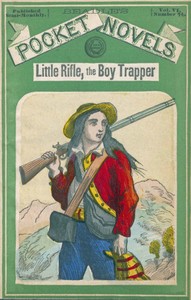
Before opening Little Rifle; or, The Young Fur Hunters — A Reader’s Guide, the edition data offers a quick orientation: 39,303 words, 2 hr 51 min estimated reading time, and 20 detected text sections.
The text analysis averages about 22.6 words per sentence, while the detected sections provide another way to judge how the source is divided.
Project Gutenberg metadata also associates the work with “Dime novels,” connecting these edition facts with the source record’s subject description.
Explore this collection
These alternatives are selected using recorded categories and estimated reading time.
About 168 minutes
Adventure Picaresque Fiction
38,456 recorded words. 3 minutes difference from this book's estimate.
View Gutenberg source #67164About 166 minutes
Adventure Picaresque Fiction
38,045 recorded words. 5 minutes difference from this book's estimate.
View Gutenberg source #66064About 160 minutes
Adventure Picaresque Fiction
36,734 recorded words. 11 minutes difference from this book's estimate.
View Gutenberg source #66932Search stored excerpts and compare books → Choose by your preferences →
Choices use stored catalog measurements. Estimates vary with reading speed. A shared category is a catalog label, not a claim that two books have the same argument or literary quality.
Search reads excerpt text stored with this catalog and links to its associated Gutenberg record. The connection is stored in the site database; this tool does not recheck that every excerpt is word-for-word identical to that external record. Excerpt search does not cover every chapter and does not verify historical publication dates.
Catalog snapshot checked: 2026-09-26. Coverage: 95 public books, 95 available source excerpts.
Calculated from edition completeness, EPUB availability, text structure and catalogue metadata. Not a user rating.
Total of 100 points, scaled to a 2.5-5.0 range. Editions with an empty description or a missing EPUB file are not scored.
Public-domain source text
The source text is kept in the dedicated reader, separate from this catalogue record and its commentary.
From its opening sentence, Little Rifle; or, The Young Fur Hunters establishes a pattern of careful, stealthy movement along the Upper Columbia. The protagonist, a boy of about fifteen, is described with a "careless grace" that belies his alertness to danger. The narrative voice, attributed to "Capt. 'Bruin' Adams," oscillates between detailed physical description and rapid action, a structure typical of the dime novel but executed here with a particular attention to the interplay of light and water.
The story opens with the boy making his way "with a care and stealth" along the riverbank, a posture that recurs throughout the excerpts. The setting is not merely backdrop but an active element: the river flows "swiftly but with a steady, unruffled sweep," and distant mountain peaks appear "like a snowy conical cloud." This careful attention to the physical environment grounds the action, even as the plot moves toward more fantastical elements like a cavern behind a waterfall. The movement between open riverbank and hidden recesses becomes a structural principle, with each scene shift marked by a change in the quality of light or sound.
A key sequence involves the protagonist and his companion Harry taking refuge behind a waterfall. The description emphasizes the waterfall's visual properties: a "thin sheet of water, scarcely thicker than the soap bubble" that reflects "prismatic hues." The boys plunge through this "gauzy vail" onto a slippery rock, and the narrative notes that the screen "instantly resumed its normal place," shutting them in while allowing them to look out. This moment functions as a threshold between visibility and concealment, a recurring motif in the excerpts. The waterfall is not merely a hiding place but a permeable boundary that distorts perception—the text describes "tremulous nebulæ" that give "a fanciful, grotesque imagery" to objects seen through the water.
The excerpts reveal a pattern of heightened sensory detail during moments of pursuit. When the protagonist realizes Blackfeet are approaching, the narrative shifts to fragmented, urgent prose: "They are coming!" he exclaims in a "terrified whisper." The sound of the waterfall becomes "thunderous din," and communication between the boys breaks down into gestures and lip-reading. This reliance on visual and auditory cues—the motion of lips, the gesture of a hand—creates a sense of immediacy and danger. The text also uses internal focalization, as when the protagonist recalls a remark by "Old Ruff Robsart" about a cavern, a memory that arrives "as if by inspiration." These details suggest a world where knowledge is passed orally and survival depends on quick, sensory-driven decisions.
Throughout the excerpts, images of concealment recur: the beaver-trap carried in the left hand, the small revolver hidden "within the bosom of the skirt," the powder-flask and bullet-pouch suspended by a string. The protagonist's dress itself—buckskin leggings, beaded moccasins—serves both as practical gear and as a form of camouflage. The most striking image is the waterfall as a "fan of the thinnest glass," which both hides and distorts. This duality—concealment that also alters perception—extends to the narrative voice, which often withholds information about the characters' plans, revealing them only through action. The reader, like the characters, is frequently in a position of partial knowledge, peering through a screen that is never fully transparent.
Readers attentive to the interplay of light, water, and movement will find in Little Rifle a more intricate structure than its dime-novel format might suggest. The recurring threshold moments—between river and cavern, visibility and concealment, sound and silence—invite a reading that attends to the physical and sensory details of the landscape. The excerpts offer a partial view, but one that rewards close attention to the patterns of pursuit and refuge that define the narrative's rhythm.
Reading about how the riverbank and waterfall shape the chase in Little Rifle, I kept thinking of that quiet tension in Under Blanco's eye; or, Hal Maynard among the Cuban insurgents — Inside the Classic—the way concealment there feels less like hiding and more like holding your breath. It stayed with me like a half-remembered scent from a walk I took once, without meaning to.
Save your reaction, strongest insight, and memorable passage.