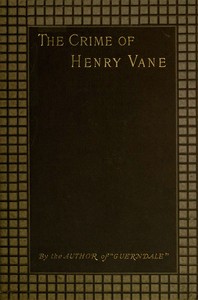
The novel opens not with Henry Vane himself, but with a club-room debate over his reputation. A group of men at the Columbian Club in New York, having just celebrated a friend's engagement, fall to discussing a man they all seem to know—or know of—named Vane. Their judgments are swift and unanimous: Vane committed a crime, and there is no excuse for it. Yet when the narrator asks for specifics, no one present has actually met him. The story is then taken up by John, who claims to have been Vane's best—and only—friend. This framing device immediately establishes a central tension: the gap between public condemnation and private understanding.
The Framed Narrative and the Unreliable Chorus
The opening pages of The Crime of Henry Vane do not plunge directly into action but instead present a social scene in which Vane is tried and convicted by hearsay. The men at the Columbian Club speak with absolute certainty: “There was no excuse for a crime like Vane’s.” Yet their knowledge is secondhand at best. One man heard the story from his brother in Paris; another from a Mrs. Malgam; most have simply “heard the story these ten years.” The narrator, who knows nothing, becomes the stand-in for the reader, prompting the tale to be told.
This structure invites skepticism. The club members are not impartial judges; they are comfortable, opinionated, and slightly drunk. The narrator explicitly notes that John’s version will be “the correct and only version according to John,” and that the crowd’s judgment may be “the judgment of the world,” but that “the world is probably right.” The novel thus signals from the start that the truth about Vane is contested, filtered through memory and bias.
Social Performance and Unspoken Tensions at the Picnic
The excerpt from the picnic scene showcases the novel’s interest in social performance and unspoken communication. The setting is a carefully orchestrated outdoor dinner, where ladies scream at insects and men struggle to sit gracefully on the grass. The dialogue is layered with subtext. When Miss Thomas asks Vane, “Are you never going to speak to me again?” and he replies, “Have you forgiven me yet?” the exchange is so quick that it “hardly could have been noticed by any one.”
Vane’s internal thoughts reveal a man distracted and self-conscious. He admires Miss Thomas’s appearance in precise, almost painterly detail—her “ivory white” dress, “dead black hair,” and “wonderful violet” eyes—but his responses to Mrs. Gower are absent-minded: “Ah—oh, yes,” and “Yes, very funny—hah!” The contrast between his roving attention and the women’s pointed remarks creates a texture of social anxiety. Miss Thomas’s insistence that she has “something to tell” him, and that she “may never tell” if not today, introduces a secret that drives the plot forward.
The Language of Judgment and the Unnamed Crime
Throughout the excerpts, the word “crime” is used repeatedly, but its nature remains deliberately vague. The club members invoke it as a self-evident label: “He acted like a fool and criminally.” Yet the narrator’s framing suggests that the crime may be more a matter of social transgression than legal offense. The subtitle, “A Study with a Moral,” reinforces this ambiguity—implying that the story is meant to teach a lesson, but not necessarily that the lesson is straightforward.
The language of the club scene is legalistic: “damned without one dissenting voice,” “Which commandment did he break?” But the setting is a smoking-room, not a courtroom. The novel seems to be exploring how reputations are formed and destroyed through gossip and collective judgment. The reader is left to wonder whether Vane’s crime is something concrete or merely a violation of social codes. The excerpts do not resolve this, but they establish that the question of guilt is central to the narrative’s structure.
Readers approaching The Crime of Henry Vane should pay close attention to the framing device and the way information is filtered through different speakers. The novel does not offer direct access to events but presents them through the lens of memory, gossip, and personal bias. The picnic scene, with its charged glances and half-finished sentences, rewards careful reading for what is left unsaid. The moral promised in the subtitle may be less about the crime itself than about the process of judging others.
Rereading The Crime of Henry Vane, I lingered on that picnic's veiled glances—how much remains unspoken between two people. It reminded me of another old story where secrets aren't confessed but acted upon quietly, a Chicago boy's scheme unfolding with the same patient tension. That earnest cunning feels like a familiar echo. A corner in corn; or, How a Chicago boy did the trick — Inside the Classic holds that same hush before the turn.