About 412 minutes
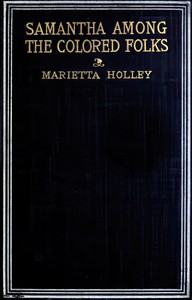
Samantha Among the Colored Folks: "My Ideas on the Race Problem" — A Reader’s Guide
Adventure Picaresque Fiction
94,550 recorded words. 0 minutes difference from this book's estimate.
View Gutenberg source #66411
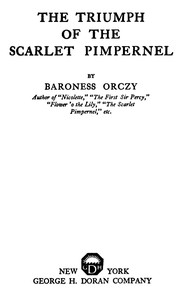
This digital edition of The Triumph of the Scarlet Pimpernel — A Reader’s Guide is described by source-level measurements including 94,666 words, 6 hr 52 min estimated reading time, and 9 detected text sections.
The text analysis averages about 16.4 words per sentence, while the detected sections provide another way to judge how the source is divided.
Project Gutenberg metadata also associates the work with “Adventure stories,” connecting these edition facts with the source record’s subject description.
Explore this collection
These alternatives are selected using recorded categories and estimated reading time.
About 412 minutes
Adventure Picaresque Fiction
94,550 recorded words. 0 minutes difference from this book's estimate.
View Gutenberg source #66411About 394 minutes
Adventure Picaresque Fiction
90,443 recorded words. 18 minutes difference from this book's estimate.
View Gutenberg source #67774About 346 minutes
Adventure Picaresque Fiction
79,503 recorded words. 66 minutes difference from this book's estimate.
View Gutenberg source #69038Search stored excerpts and compare books → Choose by your preferences →
Choices use stored catalog measurements. Estimates vary with reading speed. A shared category is a catalog label, not a claim that two books have the same argument or literary quality.
Search reads excerpt text stored with this catalog and links to its associated Gutenberg record. The connection is stored in the site database; this tool does not recheck that every excerpt is word-for-word identical to that external record. Excerpt search does not cover every chapter and does not verify historical publication dates.
Catalog snapshot checked: 2026-09-26. Coverage: 95 public books, 95 available source excerpts.
Calculated from edition completeness, EPUB availability, text structure and catalogue metadata. Not a user rating.
Total of 100 points, scaled to a 2.5-5.0 range. Editions with an empty description or a missing EPUB file are not scored.
Public-domain source text
The source text is kept in the dedicated reader, separate from this catalogue record and its commentary.
The opening chapter of The Triumph of the Scarlet Pimpernel begins not with action but with a sweeping historical meditation. The narrator reflects on the five years since the fall of the Bastille, tracing a path from the promise of liberty to the tyranny of the Committee of Public Safety. This extended prologue, nearly a page long, establishes a tone of bitter irony: the revolution that sought freedom has become a machine of arbitrary cruelty. The chapter epigraph—"The Everlasting Stars Look Down"—frames the human drama against an indifferent cosmos, a device Orczy uses throughout to underscore the smallness of individual lives amid vast historical forces.
Each chapter in the novel is headed by a quotation, often from Shakespeare or the Bible, that foreshadows or comments on the events to follow. For instance, Chapter II is titled "Feet of Clay," Chapter III "The Fellowship of Grief," and Chapter IV "One Dram of Joy Must Have a Pound of Care." These epigraphs serve as a kind of moral gloss, inviting the reader to interpret the action through a lens of proverbial wisdom. The epigraphs also create a rhythm, alternating between hope and despair, which mirrors the plot's oscillation between peril and rescue. Notably, the epigraphs are not always directly tied to the chapter's content; instead, they function as a poetic counterpoint, enriching the narrative's emotional texture.
The novel shifts between two primary settings: revolutionary France and the relative safety of England. The excerpts show a transition from the narrator's historical overview to a detailed scene at The Fisherman's Rest, an English inn. This movement is not merely geographical but tonal. In France, the prose is dense with political commentary and abstract nouns—"Liberty," "Fraternity," "Tyranny"—while the English scenes are concrete, filled with sensory details: the noise of crockery, the glow of a fire, the feel of a rough boot. The contrast highlights the precariousness of the characters' existence; even in England, the shadow of France looms. Theresia Cabarrus, a Frenchwoman, moves through the inn with caution, her every action shaped by the danger she has fled.
Orczy repeatedly uses light and darkness to signal emotional states and moral clarity. In the opening, the "everlasting stars" look down with "immortal pity," suggesting a cold, distant light. Later, Theresia observes Bertrand Moncrif sitting in the dim light of a small oil-lamp, staring into embers. The fire's glow is the only warmth in the scene, yet it is dying. Theresia herself is described as having a "triumph" in her eyes, a light that contrasts with Bertrand's despair. This pattern recurs throughout the novel: characters are often illuminated by candlelight, moonlight, or the glow of a hearth, while danger lurks in shadows. The imagery reinforces the theme of hidden identities and the precariousness of safety.
The excerpts introduce Theresia as a figure of quiet authority. Disguised in rough clothing, she moves through The Fisherman's Rest with deliberate purpose, drawing curtains to ensure privacy. Her interaction with Bertrand reveals a power dynamic: he kneels at her feet, weeping, while she stands still, her lips curved in an "undefinable smile." The narrative emphasizes her control—she is "practical and deliberate"—and her emotional distance. This characterization sets her apart from the more passive heroines of earlier Scarlet Pimpernel novels. Theresia is not merely a damsel in distress; she is a strategist, capable of manipulating those around her. Her presence complicates the usual rescue narrative, suggesting that the novel may explore themes of agency and sacrifice.
Readers approaching The Triumph of the Scarlet Pimpernel should pay close attention to the chapter epigraphs and the shifts in setting, as these structural elements reveal Orczy's commentary on the revolution's aftermath. The novel rewards careful reading of its visual imagery—light, shadow, fire—which often carries more emotional weight than the dialogue. While the excerpts offer only a glimpse, they suggest a work that balances political critique with personal drama, using the familiar framework of the Scarlet Pimpernel series to explore darker themes of power and survival.
There’s a certain quiet ache to Orczy’s 1922 novel—the way light keeps fighting through the dark between France and England. It reminded me, for reasons I can’t fully trace, of Their Child — Key Ideas to Explore. Something about how hope lingers unanswered, waiting patiently where you least expect it. Perhaps that’s it.
Answer a few questions and save a private reflection on this device.