About 168 minutes
The Crime of Henry Vane: A Study with a Moral — Reading Notes
Adventure Picaresque Fiction
38,456 recorded words. 2 minutes difference from this book's estimate.
View Gutenberg source #67164
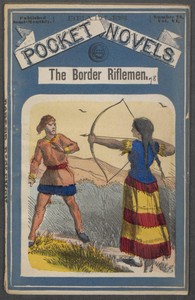
For The Border Riflemen; or, The Forest Fiend. A Romance of the Black-Hawk Uprising — Story, Setting & Ideas, the stored edition analysis reports 38,045 words, 2 hr 46 min estimated reading time, and 5 detected text sections.
The text analysis averages about 16.5 words per sentence, while the detected sections provide another way to judge how the source is divided.
Project Gutenberg metadata also associates the work with “Dime novels,” connecting these edition facts with the source record’s subject description.
Explore this collection
These alternatives are selected using recorded categories and estimated reading time.
About 168 minutes
Adventure Picaresque Fiction
38,456 recorded words. 2 minutes difference from this book's estimate.
View Gutenberg source #67164About 171 minutes
Adventure Picaresque Fiction
39,303 recorded words. 5 minutes difference from this book's estimate.
View Gutenberg source #65923About 160 minutes
Adventure Picaresque Fiction
36,734 recorded words. 6 minutes difference from this book's estimate.
View Gutenberg source #66932Search stored excerpts and compare books → Choose by your preferences →
Choices use stored catalog measurements. Estimates vary with reading speed. A shared category is a catalog label, not a claim that two books have the same argument or literary quality.
Search reads excerpt text stored with this catalog and links to its associated Gutenberg record. The connection is stored in the site database; this tool does not recheck that every excerpt is word-for-word identical to that external record. Excerpt search does not cover every chapter and does not verify historical publication dates.
Catalog snapshot checked: 2026-09-26. Coverage: 95 public books, 95 available source excerpts.
Calculated from edition completeness, EPUB availability, text structure and catalogue metadata. Not a user rating.
Total of 100 points, scaled to a 2.5-5.0 range. Editions with an empty description or a missing EPUB file are not scored.
Public-domain source text
The source text is kept in the dedicated reader, separate from this catalogue record and its commentary.
The novel opens with a detailed, painterly description of a frontier cabin at sunset—'a silvan spot' with flowers, ivy, and a young girl named Sadie drawing water. The prose lingers on her 'native grace' and 'sunny beauty,' quoting Whittier's Maud Müller. This pastoral calm is immediately undercut by the chapter title 'The Border Suitor—Cooney Joe,' hinting at romantic and violent tensions. The contrast between idyllic setting and impending conflict is a key structural device.
The opening chapter establishes a peaceful domestic scene, but the excerpts quickly shift to extended combat sequences. By Chapter VIII, the narrative focuses on a bush fight where Captain Melton's riflemen face Sac warriors led by Napope. The prose becomes terse and tactical: 'Pass the word down the line to have a charge ready for the rush.' The earlier lyrical descriptions give way to precise military maneuvers—flanking parties, divided fire, and hand-to-hand fighting with 'knife, hatchet, and clubbed rifle.' This abrupt tonal shift suggests the novel uses the pastoral opening as a foil for the violence to come.
The title's 'Forest Fiend' appears only in the table of contents as a chapter heading (Chapter X). In the excerpts, no character is explicitly called by this name. The phrase may refer to a specific antagonist or to the general menace of the wilderness. Readers should note this gap between the lurid title and the text's actual content. The moniker functions as a marketing hook rather than a literal description, a common dime-novel strategy. The story's real focus is on collective action—the riflemen as a group—rather than a single monstrous figure.
Cooney Joe, a border scout, speaks in marked dialect: 'We have got ourselves into a pizen scrape, Cap.' His folksy idiom contrasts with the narrator's formal register. Other characters, like Captain Melton, use standard English. This linguistic divide reinforces class and regional distinctions typical of dime novels. The excerpts do not reveal Sadie's role beyond the opening scene, but her absence from the battle chapters suggests the narrative splits between domestic and martial spheres. Readers should watch for how dialect marks allegiance or expertise.
At 38,045 words, the novel is brief, but the excerpts show a dense, episodic structure. Chapters are short (e.g., 'Overboard,' 'The First Blow'), each advancing the plot through action. The battle scene in Chapter VIII builds tension through incremental setbacks—flanking attacks, a report of 'Injins coming across the plain'—before a whistle signal rallies the riflemen. This rhythm of crisis and resolution mirrors serial publication. First-time readers should expect rapid scene changes and minimal exposition between set pieces.
Approach The Border Riflemen as a fast-paced adventure where setting and dialect carry as much weight as plot. The excerpts reveal a writer skilled at alternating calm and chaos, but the full novel may resolve or complicate the 'Forest Fiend' promise. Pay attention to how the riflemen's collective identity is built through repeated calls to action and shared slang. The romance hinted at in the opening may or may not return—the excerpts leave that thread dangling.
There’s a particular ache in watching the prairie turn from pastoral to powder-smoke in The Border Riflemen, that shift from quiet grass to sudden violence. It reminded me of another old reading, where the sea does the same trick—steady horizon, then the crash. I kept thinking of List, Ye Landsmen! A Romance of Incident — A Closer Reading, and how both books hold that same hush before the storm breaks.
Your answers remain private and are stored only in this browser.