About 412 minutes
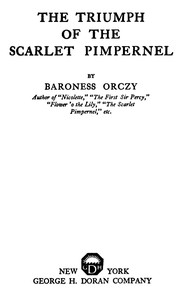
The Triumph of the Scarlet Pimpernel — A Reader’s Guide
Adventure Picaresque Fiction
94,666 recorded words. 0 minutes difference from this book's estimate.
View Gutenberg source #65695
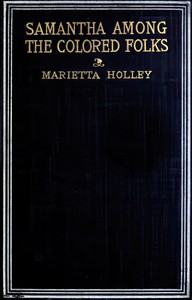
The catalog record for Samantha Among the Colored Folks: "My Ideas on the Race Problem" — A Reader’s Guide provides practical reading context through 94,550 words, 6 hr 52 min estimated reading time, and 25 detected text sections.
The text analysis averages about 24.7 words per sentence, while the detected sections provide another way to judge how the source is divided.
Project Gutenberg metadata also associates the work with “African Americans -- Fiction,” connecting these edition facts with the source record’s subject description.
Explore this collection
These alternatives are selected using recorded categories and estimated reading time.
About 412 minutes
Adventure Picaresque Fiction
94,666 recorded words. 0 minutes difference from this book's estimate.
View Gutenberg source #65695About 394 minutes
Adventure Picaresque Fiction
90,443 recorded words. 18 minutes difference from this book's estimate.
View Gutenberg source #67774About 346 minutes
Adventure Picaresque Fiction
79,503 recorded words. 66 minutes difference from this book's estimate.
View Gutenberg source #69038Search stored excerpts and compare books → Choose by your preferences →
Choices use stored catalog measurements. Estimates vary with reading speed. A shared category is a catalog label, not a claim that two books have the same argument or literary quality.
Search reads excerpt text stored with this catalog and links to its associated Gutenberg record. The connection is stored in the site database; this tool does not recheck that every excerpt is word-for-word identical to that external record. Excerpt search does not cover every chapter and does not verify historical publication dates.
Catalog snapshot checked: 2026-09-26. Coverage: 95 public books, 95 available source excerpts.
Calculated from edition completeness, EPUB availability, text structure and catalogue metadata. Not a user rating.
Total of 100 points, scaled to a 2.5-5.0 range. Editions with an empty description or a missing EPUB file are not scored.
Public-domain source text
The source text is kept in the dedicated reader, separate from this catalogue record and its commentary.
The novel opens with Samantha, Josiah Allen's wife, reflecting on her evolving ideas about race. In the excerpts, she describes listening to Victor, a young Black man who advocates for African colonization. Her narration is marked by a colloquial, self-deprecating voice—she speaks of being 'riz up' and 'eppisoding' to herself—and a tendency to shift positions mid-thought. The text includes illustrations by E. W. Kemble, such as one captioned 'The dumb Fools!' and another showing Uncle Nate Gowdey, which visually punctuate the narrative. Holley uses Samantha's perspective to explore the 'race problem' without offering a single, stable argument.
Samantha's narration is the novel's central device. She speaks in a heavy dialect—'I sot demute,' 'I hain't one to go half way'—and frequently undercuts her own pronouncements. When she hears Victor's plan for a colony in Africa, she admits, 'I felt that I wouldn't take it back. No; I had spoke my mind as things seemed to me then,' but then immediately pivots: 'the more Victor talked the more I felt that his idees wuz right.' This pattern of assertion and reversal recurs throughout the excerpts. Her voice is also comic: she offers Victor 'a bushel of my best dried apples' and 'a dozen of them pans' for Africa, mixing earnest support with absurd practicality. Readers should attend to how Samantha's language—her metaphors, her asides, her self-corrections—reveals a character who is both opinionated and uncertain.
Victor is described in physical and moral detail that contrasts with Samantha's rambling style. He has 'a clear-cut, resolute face' and eyes that 'would fairly melt sometimes, and then agin they would look you through and through.' Samantha presents him as earnest, Christian, and devoted to 'the welfare of his mother's people.' His arguments for colonization are given at length, and Samantha reports them with admiration. Yet the excerpts do not show Victor's own speech directly; we only hear Samantha's paraphrase. This indirect presentation means Victor's ideas are filtered through her consciousness. The reader must gauge how much of his position is Holley's own and how much is a foil for Samantha's developing views. The illustrations—such as 'The Leader' and 'Felix and the Teacher'—offer visual interpretations of Black characters that may reinforce or complicate the text's racial politics.
Samantha frequently uses extended metaphors and digressions to process her thoughts. She speaks of 'drawing metafors further' than ever before and 'eppisoding to myself.' For instance, she cannot 'keep Sarah out of my mind' when thinking of Africa, conflating the biblical desert with colonization. These rhetorical habits are not mere decoration; they show how Samantha grapples with abstract ideas through concrete, often domestic, imagery. Her offer of dried apples, pans, and hens turns a political scheme into a household provisioning. The novel's structure—25 text sections, each likely containing such digressions—means that the argument about race is embedded in comic, quotidian detail. Readers should watch for how Samantha's metaphors shift her stance, sometimes undermining the very points she seems to endorse.
The illustrations by E. W. Kemble are listed in detail, with captions like 'The old and feeble Ones,' 'A Ku-Kluxer,' and 'Under the white Cross.' These images appear at specific points in the narrative, often depicting scenes or characters described in the text. For example, the illustration 'The dumb Fools!' likely accompanies a moment of frustration or satire. Kemble's style—caricature-like, with exaggerated features—was common in period racial imagery. The interplay between Samantha's sympathetic but limited perspective and Kemble's visual choices creates a layered reading experience. The publisher's note explains that the title was changed from Samantha on the Race Problem to Samantha Among the Colored Folks for the popular edition, signaling a shift in marketing. Readers should consider how the illustrations frame the characters and whether they reinforce or critique Samantha's views.
Because the excerpts cover only portions of the novel, a first reading should focus on Samantha's narrative voice as the primary lens. Her contradictions and comic digressions are not flaws but deliberate strategies for exploring a contentious topic. Pay attention to how Holley balances humor with serious argument, and note where the illustrations and captions add another layer of meaning. The novel does not resolve the 'race problem' but rather presents one woman's ongoing, messy engagement with it.
I keep coming back to how Samantha wobbles between certainty and doubt, her voice tripping over its own goodwill. That same ache of loving someone while missing their truth lingers with me after reading Samantha Among the Colored Folks. It reminded me, gently, of the quiet complications I found in Their Child — Key Ideas to Explore—a different story, but the same tender bewilderment when we try to see each other whole.
Your answers remain private and are stored only in this browser.