About 85 minutes
The Beneficent Burglar — Reading Companion
Adventure Picaresque Fiction
19,403 recorded words. 10 minutes difference from this book's estimate.
View Gutenberg source #66872
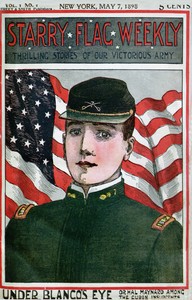
This digital edition of Under Blanco's eye; or, Hal Maynard among the Cuban insurgents — Inside the Classic is described by source-level measurements including 21,827 words, 1 hr 35 min estimated reading time, and 16 detected text sections.
The text analysis averages about 13.1 words per sentence, while the detected sections provide another way to judge how the source is divided.
Project Gutenberg metadata also associates the work with “Spanish-American War, 1898 -- Fiction,” connecting these edition facts with the source record’s subject description.
Explore this collection
These alternatives are selected using recorded categories and estimated reading time.
About 85 minutes
Adventure Picaresque Fiction
19,403 recorded words. 10 minutes difference from this book's estimate.
View Gutenberg source #66872About 84 minutes
Adventure Picaresque Fiction
19,145 recorded words. 11 minutes difference from this book's estimate.
View Gutenberg source #65282About 106 minutes
Adventure Picaresque Fiction
24,236 recorded words. 11 minutes difference from this book's estimate.
View Gutenberg source #67150Search stored excerpts and compare books → Choose by your preferences →
Choices use stored catalog measurements. Estimates vary with reading speed. A shared category is a catalog label, not a claim that two books have the same argument or literary quality.
Search reads excerpt text stored with this catalog and links to its associated Gutenberg record. The connection is stored in the site database; this tool does not recheck that every excerpt is word-for-word identical to that external record. Excerpt search does not cover every chapter and does not verify historical publication dates.
Catalog snapshot checked: 2026-09-26. Coverage: 95 public books, 95 available source excerpts.
Calculated from edition completeness, EPUB availability, text structure and catalogue metadata. Not a user rating.
Total of 100 points, scaled to a 2.5-5.0 range. Editions with an empty description or a missing EPUB file are not scored.
Public-domain source text
The source text is kept in the dedicated reader, separate from this catalogue record and its commentary.
The story opens with a frantic scene on a Havana wharf: Hal Maynard, the only American left behind as the last U.S. steamer departs, is surrounded by a jeering Spanish crowd. The narrative immediately establishes a pattern of physical urgency—running, shouting, elbowing—that recurs throughout. The crowd’s cry to “throw the Yankee dog into the harbor” ties the personal predicament to the larger context of the Maine’s sinking and the impending war.
The book is divided into three parts, each with its own title and chapter grouping. This structure mirrors the protagonist’s journey: from trapped in Havana, to joining the insurgents, to fighting under Cuba’s flag. The serialized origin (Starry Flag Weekly, May 7, 1898) is evident in the episodic, cliffhanger-driven pacing.
From the opening chase on the wharf to the later escape from the Prefatura, the narrative is driven by scenes of being hunted. Hal is repeatedly cornered by hostile crowds, Spanish authorities, or suspicious figures. The word “stop” appears at the very start, and the action rarely pauses. Even when Hal is safe aboard Captain Blodgett’s vessel, the conversation quickly turns to the next escape—into the Cuban countryside.
Hunger is another recurring image. When Hal and Juan Ramirez prepare to leave, Captain Blodgett offers them a meal, noting that “starvation reigns” on the island. Juan, despite his excitement, eats “like one famished,” and Hal admits he is “hungry, and not ashamed to say so.” This detail grounds the adventure in bodily need, contrasting the lofty ideals of fighting for Cuba with the immediate reality of scarce food.
Money is a concrete thread in the excerpts. Hal carries a bag of cash—two thousand dollars belonging to his employer, plus sixty dollars of his own. The counting and division of the money is described precisely: “Two thousand dollars was restored to the bag. The balance, sixty dollars, Hal stowed away in his own pockets.” This transaction is not just financial; it marks Hal’s transition from employee to independent agent.
Later, Hal offers all his money to Cuba, saying “Henceforth, it belongs to Cuba.” The purchase of a gun is mentioned as a barrier to joining the insurgents—Juan lacked the twenty-five dollars for a rifle. Hal’s funds thus become the literal ticket to the rebellion. The dime novel’s format, priced at five cents, mirrors this theme of small sums enabling large actions.
Dialogue carries much of the characterization. Hal’s speech is direct and impulsive: “Don’t leave me behind!” and “I offer myself as a recruit to fight Spain!” Juan Ramirez, by contrast, uses more formal, emotional language: “Santa Maria! Do you mean, senor, that——” and “At last I am to be able to join the Cuban army.” The contrast between Hal’s plain American English and Juan’s slightly stilted, translated Spanish marks their cultural difference.
The dialogue also reveals the story’s didactic side. When Hal insists on joining, Juan objects that “this rebellion is not your affair,” and Hal counters with a list of Americans already fighting under Gomez and Garcia. This exchange serves as a miniature debate on intervention, typical of the period’s adventure fiction.
The narrative alternates between enclosed, threatening spaces and open, hopeful ones. The story begins on a wharf—a liminal space between land and sea—then moves to the deck of the Fern, then to Captain Blodgett’s cabin. Each interior space offers temporary safety but also confinement. The Prefatura (police station) is another confined space, from which Hal must escape.
The goal is always the “long grass” of the Cuban countryside, where the insurgents operate. When Hal declares he will go “to the long grass, if you will take me,” he names the open, uncontrolled space that represents freedom and action. The movement from Havana’s urban wharves to the interior is a journey from Spanish control to Cuban resistance, mapped onto physical geography.
This dime novel, published at the outbreak of the Spanish-American War, uses a breakneck pace and recurring images of pursuit, hunger, and money to propel its adventure plot. Readers should note the three-part structure and the way each chapter ends with a decision or a cliffhanger. The story’s value lies less in historical accuracy than in its snapshot of popular American attitudes toward Cuba in 1898: a mix of sympathy, adventure-seeking, and a belief in individual action.
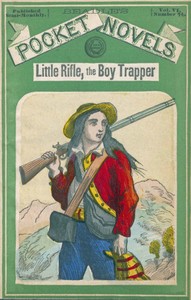
There’s a particular ache in Under Blanco’s Eye—boys running on empty, the flag always ahead. It reminds me of an old friend, that same hunger for open country in Little Rifle; or, The Young Fur Hunters — A Reader’s Guide. I read them decades apart, yet both left that same quiet, wistful feeling, like watching a campfire die down.
Your answers remain private and are stored only in this browser.