About 120 minutes
Hilda Strafford: A California Story — Text and Context
Adventure Picaresque Fiction
27,467 recorded words. 4 minutes difference from this book's estimate.
View Gutenberg source #67881
Before opening Cavalry Curt; Or, The Wizard Scout of the Army — Context and Discussion, the edition data offers a quick orientation: 26,576 words, 1 hr 56 min estimated reading time, and 25 detected text sections.
The text analysis averages about 12.2 words per sentence, while the detected sections provide another way to judge how the source is divided.
Project Gutenberg metadata also associates the work with “United States -- History -- Civil War, 1861-1865 -- Fiction,” connecting these edition facts with the source record’s subject description.
Explore this collection
These alternatives are selected using recorded categories and estimated reading time.
About 120 minutes
Adventure Picaresque Fiction
27,467 recorded words. 4 minutes difference from this book's estimate.
View Gutenberg source #67881About 107 minutes
Adventure Picaresque Fiction
24,480 recorded words. 9 minutes difference from this book's estimate.
View Gutenberg source #68548About 106 minutes
Adventure Picaresque Fiction
24,236 recorded words. 10 minutes difference from this book's estimate.
View Gutenberg source #67150Search stored excerpts and compare books → Choose by your preferences →
Choices use stored catalog measurements. Estimates vary with reading speed. A shared category is a catalog label, not a claim that two books have the same argument or literary quality.
Search reads excerpt text stored with this catalog and links to its associated Gutenberg record. The connection is stored in the site database; this tool does not recheck that every excerpt is word-for-word identical to that external record. Excerpt search does not cover every chapter and does not verify historical publication dates.
Catalog snapshot checked: 2026-09-26. Coverage: 95 public books, 95 available source excerpts.
Calculated from edition completeness, EPUB availability, text structure and catalogue metadata. Not a user rating.
Total of 100 points, scaled to a 2.5-5.0 range. Editions with an empty description or a missing EPUB file are not scored.
Public-domain source text
The source text is kept in the dedicated reader, separate from this catalogue record and its commentary.
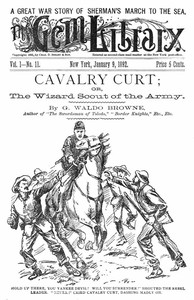
The novel opens with a staged confrontation: a sentry's challenge, a countersign exchange, and a sudden dash. The line 'Hold up there, you Yankee devil!' establishes immediate tension, while the protagonist's horse, Wildbird, is named in the first chapter. The scene is set at daybreak on May 6, 1864, in northern Georgia, grounding the adventure in Sherman's campaign. The reader is thrust into action without preamble, learning character through movement rather than description.
The opening chapter introduces Cavalry Curt through his actions: he charges past a sentry, escapes, and is later described as 'the reckless rider.' His horse, Wildbird, is given a personality, and Curt's dialogue is limited to commands like 'On, Wildbird, on!' The narrative prioritizes physical momentum over interiority. A first-time reader will notice that Curt's motivations are not explained; he is simply a Union scout in Confederate territory. The dime novel format relies on this kinetic introduction to hook the reader, with character traits emerging from how he handles danger.
In the middle excerpt, Curt infiltrates a Confederate scouting party. The text reveals his internal conflict: he recognizes a voice from his past, a man who 'had at one time belonged to Kearney’s cavalry' but disappeared. Curt resolves to 'maintain a careful watch over himself,' suspecting the man has deserted. This moment of recognition creates dramatic irony—the reader knows Curt is a spy, but the other characters do not. The narrative shifts between Curt's external actions and his private calculations, offering a glimpse of the psychological strain beneath the adventure surface.
The novel weaves real Civil War events into its plot. The excerpts reference Sherman's advance, McPherson's attack on Reseca, and Johnston's defensive maneuvers. The text notes that 'the march to Reseca was performed with the ease and rapidity that marked the Confederate commander’s entire campaign.' These historical details serve as a backdrop for the fictional action, but the narrative does not pause to explain them. A first-time reader may need to infer the strategic context from passing mentions, as the story prioritizes the scout's immediate peril over historical exposition.
The dialogue in the excerpts is marked by colloquial speech and period slang. Confederate characters use phrases like 'I kalkilate' and 'foller me,' while Curt's countersign is the single word 'Freedom.' The sentry's challenge—'Halt! who comes there?'—is a formulaic military call, but the rebel leader's shout 'Hold up there, you Yankee devil!' injects a personal, antagonistic tone. These linguistic choices create a sense of immediacy and regional flavor, though the narrator's own voice remains formal and omniscient, occasionally addressing the reader directly ('Cavalry Curt, we remember').
Readers approaching this dime novel for the first time should pay attention to how Browne balances action with historical detail. The excerpts suggest a narrative that moves quickly, relying on recognizable Civil War settings to lend weight to the spy's adventures. Curt's internal thoughts, when they appear, offer a counterpoint to the external action. The novel rewards attention to small details—a horse's name, a countersign, a familiar voice—that build a layered portrait of a scout at war.
There’s a strange tenderness in watching Curt wrestle with his conscience amid the war’s noise—it reminds me how Browne’s era kept circling the same quiet questions. That old ache surfaces again in reading about Samantha’s own fumbling toward kindness. It’s a gentler echo, perhaps, but the wistfulness lingers. Samantha Among the Colored Folks: "My Ideas on the Race Problem" — A Reader’s Guide sits nearby on my shelf, and I find myself thinking of both books together, softly.
Build a private reading journal entry for this title.