1

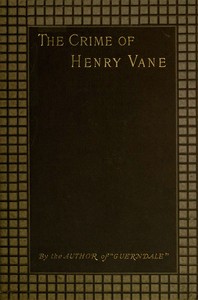
The Crime of Henry Vane: A Study with a Moral — Reading Notes
(10 User reviews)
1444
Project Gutenberg
2022
Not confirmed
New York (N.Y.) -- Fiction; Man-woman relationships -- Fiction; Single men -- Fiction
Readers of public-domain and historical texts
Project Gutenberg digital edition
en
Edition facts
Words
38,456
Reading time
168 min
Text sections
28
The Crime of Henry Vane: A Study with a Moral — Reading Notes can be approached with a clearer sense of reading commitment from its source measurements: 38,456 words, 2 hr 48 min estimated reading time, and 28 detected text sections.
The text analysis averages about 16.1 words per sentence, while the detected sections provide another way to judge how the source is divided.
Project Gutenberg metadata also associates the work with “New York (N.Y.) -- Fiction,” connecting these edition facts with the source record’s subject description.
Source:
Project Gutenberg record #67164
In this 1884 novel, a framed narrative at the Columbian Club introduces Henry Vane's ambiguous 'crime' through conflicting judgments. Excerpts reveal a tense picnic scene with sharp dialogue, social maneuvering, and a mysterious secret between Vane and Miss Thomas.
Editorial Edition Score
4.8/5
★★★★★
★★★★★
Calculated from edition completeness, EPUB availability, text structure and catalogue metadata. Not a user rating.
How this score is calculated
- Description quality20 pts
- Title & short description10 pts
- Source metadata20 pts
- Text length15 pts
- Chapters / structure15 pts
- EPUB file integrity20 pts
Total of 100 points, scaled to a 2.5-5.0 range. Editions with an empty description or a missing EPUB file are not scored.
Edition quality
Read the Text
All were unanimous. There was no excuse for a crime like Vane's. Evidently they all knew Vane. He was damned without one dissenting voice.
"Who was Vane?" said I, "and what did he do? Which commandment did he break? He must have made merry with them all--or, rather, have kept them all to get such a judgment in this club."
A babel of voices arose. All these men were intimate friends; and they were sitting in one of the small smoking-rooms of the Columbian Club in New York. John had just engaged himself to be married, and we had given him a dinner; or, as Pel Schuyler put it, we were "recording his mortgage." Schuyler was a real-estate broker.
"Now, look here," said John, "how many of you fellows know Vane personally?"
No one, apparently. There was a moment's silence. Then the Major spoke up. "Bah!" said he, "I have heard the story these ten years." "So have I!" chimed in several others. "My brother knew Vane in Paris," said Pel. "I had it from Mrs. Malgam herself," simpered Daisy Blake, fatuously.
"Well, at least, I know nothing of it," I said; "tell it for my benefit, John."
"Yes, yes," cried they, "let's hear the correct and only version according to John."
It was that critical moment in a dinner, when the fireworks of champagne have sputtered out, and the burgundy invites to somnolence. All had lit their cigars, and felt more like listening than talking. John did not smoke.
"I will," said he. "At that time, I was his best--I may say, his only friend."
"And I say, still," said the Major, "he acted like a fool and criminally. There can be no excuse for such conduct."
John shrugged his shoulders and began. Of course, I do not mean that he told the whole story just as I have written it. He related the bare facts, with little comment and without conversations. Whether you condemned the man or excused him, John thought, his story might be understood, even if his folly were not forgiven. The crowd at the club did neither; and, perhaps, their judgment is the judgment of the world; and the world is probably right. But we may learn from folly; it is sometimes more suggestive than common sense. There is the ordinary success and there is the exceptional failure; that is pleasanter, but this is more instructive. Extreme cases fix the law.
The world is probably right; and, to those of us who are healthily adapted to our environment, the world is enough. Blessed are they who are fitted, for they shall survive. The world is enough; but the poet sang, love is enough. Shall we say, love is surplusage? The world is always right; and how virtuously the healthy world reproves what is morbid! How all the world unites in condemning him who is not fully content with itself! For such an one it cannot even spare its pity. There is a kind of personal animus in its contempt.
Let us hasten to join our little voices to swell the universal song. So John told the story--plainly and coldly, the more adversely for the lingering doubt; so we tell the story, and the doubt lessens as we state the facts, and quite vanishes as we reach the end. It is the story of a common crime, and the criminal is no friend of ours, as he was of John's. Moreover, Schuyler called the criminal a fool.
IN April, 1873, Henry Vane was sitting on the _perron_ of a small summer house in Brittany, poking the pebbles in the driveway with his cane. He had been there for half an hour, and there was nothing in his appearance and attitude to indicate that he would not be there for half an hour more. There was one red pebble, in particular, which he had an especial desire to prod out from among the others, which were gray. But it was round and slippery, and slid about the ferruled end of his cane. After poking it some time, he desisted and held the cane in his hands in front of his knees, which, as the next step of the porch was not much lower, were as high as his chin. "C'en est fait de moi," he muttered.
Henry Vane, though a New Yorker, had been brought up in France, and in the French language his thoughts came most readily. He had just seen, for the last time, an old friend of his--a girl, whom he had known in infancy, in childhood, in maidenhood; and whom it seemed incredible, impossible, intolerable, that he should know no more. It was upon the piazza of her uncle's house that he was sitting; and she was to leave the next day for Switzerland.
The novel opens not with Henry Vane himself, but with a club-room debate over his reputation. A group of men at the Columbian Club in New York, having just celebrated a friend's engagement, fall to discussing a man they all seem to know—or know of—named Vane. Their judgments are swift and unanimous: Vane committed a crime, and there is no excuse for it. Yet when the narrator asks for specifics, no one present has actually met him. The story is then taken up by John, who claims to have been Vane's best—and only—friend. This framing device immediately establishes a central tension: the gap between public condemnation and private understanding.
The Framed Narrative and the Unreliable Chorus
The opening pages of The Crime of Henry Vane do not plunge directly into action but instead present a social scene in which Vane is tried and convicted by hearsay. The men at the Columbian Club speak with absolute certainty: “There was no excuse for a crime like Vane’s.” Yet their knowledge is secondhand at best. One man heard the story from his brother in Paris; another from a Mrs. Malgam; most have simply “heard the story these ten years.” The narrator, who knows nothing, becomes the stand-in for the reader, prompting the tale to be told.
This structure invites skepticism. The club members are not impartial judges; they are comfortable, opinionated, and slightly drunk. The narrator explicitly notes that John’s version will be “the correct and only version according to John,” and that the crowd’s judgment may be “the judgment of the world,” but that “the world is probably right.” The novel thus signals from the start that the truth about Vane is contested, filtered through memory and bias.
Social Performance and Unspoken Tensions at the Picnic
The excerpt from the picnic scene showcases the novel’s interest in social performance and unspoken communication. The setting is a carefully orchestrated outdoor dinner, where ladies scream at insects and men struggle to sit gracefully on the grass. The dialogue is layered with subtext. When Miss Thomas asks Vane, “Are you never going to speak to me again?” and he replies, “Have you forgiven me yet?” the exchange is so quick that it “hardly could have been noticed by any one.”
Vane’s internal thoughts reveal a man distracted and self-conscious. He admires Miss Thomas’s appearance in precise, almost painterly detail—her “ivory white” dress, “dead black hair,” and “wonderful violet” eyes—but his responses to Mrs. Gower are absent-minded: “Ah—oh, yes,” and “Yes, very funny—hah!” The contrast between his roving attention and the women’s pointed remarks creates a texture of social anxiety. Miss Thomas’s insistence that she has “something to tell” him, and that she “may never tell” if not today, introduces a secret that drives the plot forward.
The Language of Judgment and the Unnamed Crime
Throughout the excerpts, the word “crime” is used repeatedly, but its nature remains deliberately vague. The club members invoke it as a self-evident label: “He acted like a fool and criminally.” Yet the narrator’s framing suggests that the crime may be more a matter of social transgression than legal offense. The subtitle, “A Study with a Moral,” reinforces this ambiguity—implying that the story is meant to teach a lesson, but not necessarily that the lesson is straightforward.
The language of the club scene is legalistic: “damned without one dissenting voice,” “Which commandment did he break?” But the setting is a smoking-room, not a courtroom. The novel seems to be exploring how reputations are formed and destroyed through gossip and collective judgment. The reader is left to wonder whether Vane’s crime is something concrete or merely a violation of social codes. The excerpts do not resolve this, but they establish that the question of guilt is central to the narrative’s structure.
Readers approaching The Crime of Henry Vane should pay close attention to the framing device and the way information is filtered through different speakers. The novel does not offer direct access to events but presents them through the lens of memory, gossip, and personal bias. The picnic scene, with its charged glances and half-finished sentences, rewards careful reading for what is left unsaid. The moral promised in the subtitle may be less about the crime itself than about the process of judging others.
Rereading The Crime of Henry Vane, I lingered on that picnic's veiled glances—how much remains unspoken between two people. It reminded me of another old story where secrets aren't confessed but acted upon quietly, a Chicago boy's scheme unfolding with the same patient tension. That earnest cunning feels like a familiar echo. A corner in corn; or, How a Chicago boy did the trick — Inside the Classic holds that same hush before the turn.
Liam Anderson
4 weeks agoTheodore Young
3 weeks agoGrayson Hernandez
2 weeks agoAnthony Hernandez
3 weeks agoThere are no comments for this eBook.
Reader reflection
Record your reading impressions
A brief reflection can help important ideas stay with you longer.
Your progress
0
/
10
2
What was your overall reaction to the book?
3
How likely are you to recommend this book?
4
Did the language feel accessible?
5
Did the book meet your expectations?
6
Did it raise ideas you would like to talk about?
7
Did the book offer a fresh perspective?
8
How did the pace of the book feel?
9
Which lesson or insight stayed with you?
10







Alexander Torres
1 month ago