About 160 minutes
The Woman of Knockaloe: A Parable — Themes and Context
Adventure Picaresque Fiction
36,734 recorded words. 0 minutes difference from this book's estimate.
View Gutenberg source #66932
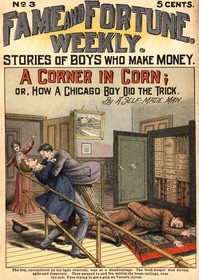
For A corner in corn; or, How a Chicago boy did the trick — Inside the Classic, the stored edition analysis reports 36,798 words, 2 hr 40 min estimated reading time, and 22 detected text sections.
The text analysis averages about 14.7 words per sentence, while the detected sections provide another way to judge how the source is divided.
Project Gutenberg metadata also associates the work with “Chicago (Ill.) -- Fiction,” connecting these edition facts with the source record’s subject description.
Explore this collection
These alternatives are selected using recorded categories and estimated reading time.
About 160 minutes
Adventure Picaresque Fiction
36,734 recorded words. 0 minutes difference from this book's estimate.
View Gutenberg source #66932About 156 minutes
Adventure Picaresque Fiction
35,674 recorded words. 4 minutes difference from this book's estimate.
View Gutenberg source #66453About 166 minutes
Adventure Picaresque Fiction
38,045 recorded words. 6 minutes difference from this book's estimate.
View Gutenberg source #66064Search stored excerpts and compare books → Choose by your preferences →
Choices use stored catalog measurements. Estimates vary with reading speed. A shared category is a catalog label, not a claim that two books have the same argument or literary quality.
Search reads excerpt text stored with this catalog and links to its associated Gutenberg record. The connection is stored in the site database; this tool does not recheck that every excerpt is word-for-word identical to that external record. Excerpt search does not cover every chapter and does not verify historical publication dates.
Catalog snapshot checked: 2026-09-26. Coverage: 95 public books, 95 available source excerpts.
Calculated from edition completeness, EPUB availability, text structure and catalogue metadata. Not a user rating.
Total of 100 points, scaled to a 2.5-5.0 range. Editions with an empty description or a missing EPUB file are not scored.
Public-domain source text
The source text is kept in the dedicated reader, separate from this catalogue record and its commentary.
The story opens in the Rookery Building, a real Chicago landmark, with a terse exchange between the speculator Jared Whitemore and his bookkeeper Edgar Vyce. The dialogue is clipped and functional: “Has Vance returned yet?” “No, sir.” This economy of speech, typical of the dime novel, prioritizes plot momentum over character interiority. The author, writing under the pseudonym “A Self-Made Man,” relies on concrete details—the office clock chiming five, the stenographer’s desk by the window—to establish a business setting quickly.
The narrative is saturated with the terminology of grain speculation: “bear pool,” “corn pit,” “visible supply,” “elevators.” Characters speak in precise financial calculations: “five million bushels of corn stored in them at this moment.” This jargon is not explained; the reader is expected to follow the mechanics of a corner. The author uses this specialized vocabulary to create an insider’s atmosphere, where the stakes are measured in bushels and dollars. The dialogue often carries the weight of exposition, as when Mr. Jarboe explains the market situation to Vance: “Corn is high, and, but for this unfortunate affair, likely to go higher.” The language is direct, avoiding metaphor or sentiment, mirroring the hard-nosed world of trade.
Vance Thornton, the “Chicago boy,” is characterized through his restrained speech. When faced with crisis, he does not exclaim but states facts: “I will have to consult with my partners.” His dialogue is marked by polite deference (“You are right, Mr. Jarboe”) and understatement. This verbal control contrasts with the high-stakes situation, suggesting a competence that the plot will test. The author grants Vance moments of quiet authority, as when he reveals the hidden corn supply: “all the same Jarrett, Palmer & Carrington have five million bushels of corn stored in them.” The voice remains level, even as others gasp. This restraint is a deliberate authorial choice to align the reader’s sympathy with the composed hero.
As a weekly dime novel, the story is structured for installment reading. Chapters end on notes of suspense: “there will be a panic in the corn pit to-morrow morning.” The narrative moves briskly from office to elevator, from conversation to crisis. The author uses short paragraphs and frequent dialogue to maintain pace. The opening chapter establishes multiple characters in a single room, then narrows focus to Vance’s mission. This efficiency in scene-setting is typical of the genre: every detail serves the plot. The serial format also explains the repetition of key information, such as the five million bushels, ensuring readers who missed an installment can follow.
The Rookery Building is more than a backdrop; it anchors the story in a specific Chicago geography. The author mentions La Salle Street, the Board of Trade Building, and the “corn pit” with the confidence of a local. This setting lends authenticity to the financial maneuvers. The office itself is “plainly furnished,” suggesting Whitemore’s focus on business over display. The contrast between the orderly office and the volatile market outside creates a tension that drives the plot. The author uses the setting to reinforce themes of control and chaos: the hero must navigate both the physical spaces of commerce and the unpredictable forces of speculation.
Dialogue in this excerpt serves multiple functions: it advances the plot, reveals character, and conveys information. The bookkeeper Vyce is sketched through his actions—tearing up a note, pacing—more than his words. Whitemore’s brief commands establish his authority. Vance’s exchanges with Mr. Jarboe are the core of the excerpt, where the crisis is laid out. The author uses dialogue to show the power dynamics: Jarboe’s “we are beaten to a standstill” versus Vance’s quiet correction. The dialogue is never ornamental; every line pushes the story forward. This functional use of speech is a hallmark of the dime novel, where economy is paramount.
Readers should note how the author balances technical detail with narrative speed. The financial machinations are never allowed to stall the action; instead, they fuel it. The pseudonym “A Self-Made Man” itself signals the story’s ethos of enterprise. Pay attention to how the author uses the constraints of the genre—short chapters, cliffhangers, functional dialogue—to create a focused tale of ambition and risk. The incomplete excerpts leave the resolution unknown, but the patterns of language and structure are already clear.
Last week I kept thinking about the Chicago boy’s clipped, money-driven hurry in A Corner in Corn, that sharp financial slang and the Rookery’s marble echoing it. It made me recall another world entirely, salt-stained and slower, where the urgency is weather and distance, not ticker tape. Curious how the same restless pulse beats beneath different costumes; I revisited List, Ye Landsmen! A Romance of Incident — A Closer Reading and found it there, quieter. Both simply tell a human scramble, just wearing different hats.
Answer a few questions and save a private reflection on this device.