About 417 minutes
Betrothed for a day: Or, Queenie Trevalyn's love test — Text and Context
Historical Psychological Social Fiction
95,804 recorded words. 12 minutes difference from this book's estimate.
View Gutenberg source #68760
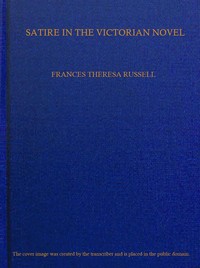
The source record for Satire in the Victorian novel — Story, Setting & Ideas measures this digital text at 98,609 words, 7 hr 9 min estimated reading time, and 28 detected text sections.
The text analysis averages about 20.3 words per sentence, while the detected sections provide another way to judge how the source is divided.
Project Gutenberg metadata also associates the work with “Thesis (Ph. D.),” connecting these edition facts with the source record’s subject description.
Explore this collection
These alternatives are selected using recorded categories and estimated reading time.
About 417 minutes
Historical Psychological Social Fiction
95,804 recorded words. 12 minutes difference from this book's estimate.
View Gutenberg source #68760About 449 minutes
Historical Psychological Social Fiction
103,159 recorded words. 20 minutes difference from this book's estimate.
View Gutenberg source #67804About 392 minutes
Historical Psychological Social Fiction
90,012 recorded words. 37 minutes difference from this book's estimate.
View Gutenberg source #68676Search stored excerpts and compare books → Choose by your preferences →
Choices use stored catalog measurements. Estimates vary with reading speed. A shared category is a catalog label, not a claim that two books have the same argument or literary quality.
Search reads excerpt text stored with this catalog and links to its associated Gutenberg record. The connection is stored in the site database; this tool does not recheck that every excerpt is word-for-word identical to that external record. Excerpt search does not cover every chapter and does not verify historical publication dates.
Catalog snapshot checked: 2026-09-26. Coverage: 95 public books, 95 available source excerpts.
Calculated from edition completeness, EPUB availability, text structure and catalogue metadata. Not a user rating.
Total of 100 points, scaled to a 2.5-5.0 range. Editions with an empty description or a missing EPUB file are not scored.
Public-domain source text
The source text is kept in the dedicated reader, separate from this catalogue record and its commentary.
Frances Theresa Russell opens her 1920 monograph with a defensive posture, acknowledging that satire, Victorianism, and the novel each suffer from critical disfavor. She likens satire to a thistle, admired only from a cold intellectual distance, while Victorianism itself carries a byword and reproach—a period whose name provokes the question whether ’twere better to be or not to be. Russell argues that the Victorian era, despite its reputation for complacency and vehemence, was not senile but adolescent in its startled responses to Darwin, Ibsen, and Higher Criticism.
The excerpts reveal a study grounded in close reading of political satire. Russell traces the satiric ball rolling through election camps, from Lytton’s Pelham to Meredith’s Beauchamp’s Career, and analyzes Disraeli’s constructive Toryism as a paradox of reformist conservatism. She cites Smollett’s Adventures of an Atom to illustrate the legerdemain of oratory, and quotes Lytton’s The Coming Race for the compound word Koom-Posh, meaning government of the most ignorant and hollow.
Russell’s preface establishes a central tension: satire, though a thistle “pricked from the thorny branches of reproof,” cannot be cherished like a fair daffodil or sweet violet. She insists it must be admired with the cold eye of intellectual appraisal, a stance that frames her entire study. This defensive tone suggests that even in 1920, satire required justification as a legitimate literary mode. Russell does not apologize for her subject but instead sharpens the reader’s awareness of satire’s prickly nature. She contrasts the Victorian period’s reputation with that of the Elizabethan (youthful exuberance) and Queen Anne (mature dignity), arguing that Victorianism suffers from a unique blight—its very name a byword. Yet she resists the charge of senility, instead attributing to Victorians a startled ingenuousness and vehemence more proper to adolescence. This framing sets up her analysis of how satirists like Lytton and Disraeli wielded reproof against political folly, using wit as a weapon rather than a flower.
Russell’s treatment of political satire draws heavily on specific novels and their targets. She notes that Lytton, starting as a Liberal and ending as a Conservative, provides counter satire against democracy. In The Coming Race, the Vrilya language includes Koom-Posh, a compound of Koom (profound hollow) and Posh (utter contempt), meaning government of the many by the most ignorant and hollow. Russell traces this contempt through Smollett’s Adventures of an Atom, which mocks oratorical legerdemain—distracting weak brains with a torrent of words without ideas. She then examines Disraeli, whose whole existence was statesmanship, and whose satire targets incapable and dishonest leadership rather than the people. Peacock’s scorn of exploiting popular ignorance is taken up by successors in portraits of the ward-politician type. Russell quotes Pelham’s repudiation of a proposed new party because of its bad personnel—men who talk much, perform nothing, and level upwards while trampling downwards. Montacute’s more concrete picture describes a man with official aptitude and volubility of routine rhetoric, who assumes the prevalent tone with cautious facility and disembarrasses himself with dexterous ambiguity. These examples show Russell’s method: linking specific textual evidence to broader patterns of satiric attack.
Russell devotes particular attention to Disraeli, whom she calls a white blackbird to contemporary critics—a reforming Tory. She notes that his satire complements destructive criticism with a definite constructive policy, a paradox that later generations, familiar with Progressive Republicanism, might understand more easily. Disraeli’s belief in rule by a selected class stemmed not from indifference to the masses but from distrust of popular ability and judgment, and a conviction that efficiency requires expert knowledge. Russell argues that from this viewpoint, satire is directed against incapable and dishonest leadership, not the people. She contrasts this with Lytton’s Night and Morning, where men lose their democratic enthusiasm, and The Coming Race, where the narrator’s father, defeated by his tailor in a congressional race, decides on the superior beauty of private life. Russell’s analysis reveals a nuanced understanding of how Victorian satirists navigated the tension between democratic ideals and practical governance, using satire to expose folly while sometimes endorsing hierarchical structures. Her evidence is drawn from specific passages, including the invented language of Koom-Posh, which encapsulates contempt for both demagogue and gullible public.
Russell’s monograph offers a systematic taxonomy of Victorian satire’s methods and objects, but the excerpts suggest she is equally interested in the cultural position of satire itself—its defensive posture, its prickly reception, and its role as intellectual appraisal rather than emotional embrace. Readers approaching this work should expect a scholarly tone grounded in close reading of primary texts, with particular attention to political novels by Lytton, Disraeli, and Peacock. The study rewards those who wish to see how satire functioned as a critical instrument within a period often dismissed as complacent.
I found myself thinking about how those Victorian satirists peeled back polite society to show the machinery underneath, and it reminded me of a quieter book that does the same with just one life. It’s called Gabrielle de Bergerac — Story, Setting & Ideas, and it lingered with me like a half-remembered conversation. That same careful watching, that gentle unmaking of assumptions, stayed long after I closed it.
Answer a few questions and save a private reflection on this device.