About 389 minutes
The Crystal Cup — Reading Companion
Historical Psychological Social Fiction
89,421 recorded words. 3 minutes difference from this book's estimate.
View Gutenberg source #65310
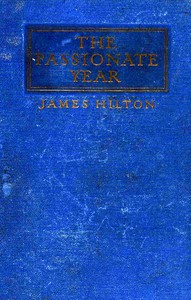
The passionate year — A Reader’s Guide can be approached with a clearer sense of reading commitment from its source measurements: 90,012 words, 6 hr 32 min estimated reading time, and 8 detected text sections.
The text analysis averages about 15.9 words per sentence, while the detected sections provide another way to judge how the source is divided.
Project Gutenberg metadata also associates the work with “England -- Fiction,” connecting these edition facts with the source record’s subject description.
Explore this collection
These alternatives are selected using recorded categories and estimated reading time.
About 389 minutes
Historical Psychological Social Fiction
89,421 recorded words. 3 minutes difference from this book's estimate.
View Gutenberg source #65310About 377 minutes
Historical Psychological Social Fiction
86,649 recorded words. 15 minutes difference from this book's estimate.
View Gutenberg source #65432About 417 minutes
Historical Psychological Social Fiction
95,804 recorded words. 25 minutes difference from this book's estimate.
View Gutenberg source #68760Search stored excerpts and compare books → Choose by your preferences →
Choices use stored catalog measurements. Estimates vary with reading speed. A shared category is a catalog label, not a claim that two books have the same argument or literary quality.
Search reads excerpt text stored with this catalog and links to its associated Gutenberg record. The connection is stored in the site database; this tool does not recheck that every excerpt is word-for-word identical to that external record. Excerpt search does not cover every chapter and does not verify historical publication dates.
Catalog snapshot checked: 2026-09-26. Coverage: 95 public books, 95 available source excerpts.
Calculated from edition completeness, EPUB availability, text structure and catalogue metadata. Not a user rating.
Total of 100 points, scaled to a 2.5-5.0 range. Editions with an empty description or a missing EPUB file are not scored.
Public-domain source text
The source text is kept in the dedicated reader, separate from this catalogue record and its commentary.
James Hilton's The Passionate Year (1924) opens with Kenneth Speed arriving at Millstead School on a 'dull glowering day towards the end of April,' a setting that immediately establishes the novel's attention to atmosphere and transition. The narrative is organized into books named after school terms—Summer, Winter, Lent—with an interlude at Christmas, a structure that mirrors the academic calendar while also marking emotional and relational shifts. The excerpts reveal a work preoccupied with the tension between public roles and private discontent, conveyed through recurring contrasts of light and shadow, and through scenes that move from the headmaster's dark study to the charged intimacy of domestic quarrels.
The novel's division into school terms is not merely a chronological device. The Summer Term opens Speed's arrival and initial impressions; the Winter Term and Lent Term likely track his deepening involvement at Millstead and his marriage to Helen. The interlude 'Christmas At Beachings Over' suggests a holiday setting that may offer a temporary escape or a crucible for conflict. This structure allows Hilton to align external seasons with internal states: the 'dull glowering day' of April contrasts with the 'stormy sincerity' of Helen's later outburst. The reader is invited to observe how the passage of terms—each with its own pressures and rhythms—shapes the characters' trajectories.
From the opening chapter, Hilton uses visual contrast to underscore mood. The headmaster's study is 'darker even than usual,' with daylight 'filtered by the thick spring foliage of lime trees' struggling 'meagrely' through small windows. Speed sees the clerical collar 'gleaming like a bar of ivory against an ebony background.' This interplay of light and darkness recurs in the marital quarrel: Helen's 'passionate outpouring' is described as 'stormy sincerity,' and Speed experiences a 'thrill of surprised and detached admiration' as if a new light has been cast on her. The imagery suggests that clarity and obscurity are not fixed states but shift with perception and emotion.
The excerpts trace a distinct movement from the professional to the personal. Speed's first scene is at Millstead, where he is nervous, gripping the headmaster's hand 'vigorously' to mask his trepidation. Later, at home, he is confronted by Helen's jealousy over Clare. The transition is abrupt: the school's formal, dimly lit study gives way to the raw, unfiltered emotion of a domestic argument. Hilton does not bridge these scenes with exposition; instead, the juxtaposition itself suggests that Speed's identity is split between two spheres. The reader sees him as a teacher and as a husband, and the contrast raises questions about which world demands more of him—and which he is less equipped to navigate.
Helen's speech in the excerpt is a turning point, marked by a shift in tone and structure. She speaks in long, unbroken sentences, accusing Kenneth of wanting her only as a 'comforter' while giving his friendship to Clare. Her language is direct and repetitive—'scandalous,' 'truth,' 'jealous'—and she refuses his attempts to 'smooth me down.' Hilton renders the scene without authorial commentary, letting Helen's words stand. Speed's reaction is one of 'astonishment at her self-revelation'; he realizes he had not known her capacity for 'proud, passionate, and sincere' expression. The quarrel is not resolved but left hanging, with Helen drawing her arm away 'determined but not contemptuous.' This moment suggests that the novel's central conflict may be less about external events than about the characters' evolving self-knowledge.
Readers approaching The Passionate Year should attend to how Hilton uses the school-term structure to frame personal crises, and how his recurring imagery of light and darkness signals shifts in understanding. The excerpts offer only a partial view—the full arc of Speed's marriage and his career at Millstead remains to be discovered—but they establish a pattern of movement between public composure and private turmoil that rewards close attention to setting and dialogue.
I’ve often thought The Passionate Year carries its school terms like a heartbeat, the light and dark of Kenneth Speed’s days as steady as that. It reminds me of a quiet kinship I once felt with a certain worn volume, The Old Card — Inside the Classic, whose old card catalog whispers similar patience—years of readers leaving faint traces behind, just like the turning terms.
Save your reaction, strongest insight, and memorable passage.