About 389 minutes
The Crystal Cup — Reading Companion
Historical Psychological Social Fiction
89,421 recorded words. 12 minutes difference from this book's estimate.
View Gutenberg source #65310
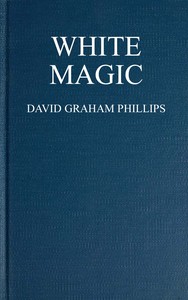
Before opening White Magic: A Novel — Reading Notes, the edition data offers a quick orientation: 86,649 words, 6 hr 17 min estimated reading time, and 24 detected text sections.
The text analysis averages about 12.1 words per sentence, while the detected sections provide another way to judge how the source is divided.
Project Gutenberg metadata also associates the work with “Love stories,” connecting these edition facts with the source record’s subject description.
Explore this collection
These alternatives are selected using recorded categories and estimated reading time.
About 389 minutes
Historical Psychological Social Fiction
89,421 recorded words. 12 minutes difference from this book's estimate.
View Gutenberg source #65310About 392 minutes
Historical Psychological Social Fiction
90,012 recorded words. 15 minutes difference from this book's estimate.
View Gutenberg source #68676About 361 minutes
Historical Psychological Social Fiction
82,876 recorded words. 16 minutes difference from this book's estimate.
View Gutenberg source #68914Search stored excerpts and compare books → Choose by your preferences →
Choices use stored catalog measurements. Estimates vary with reading speed. A shared category is a catalog label, not a claim that two books have the same argument or literary quality.
Search reads excerpt text stored with this catalog and links to its associated Gutenberg record. The connection is stored in the site database; this tool does not recheck that every excerpt is word-for-word identical to that external record. Excerpt search does not cover every chapter and does not verify historical publication dates.
Catalog snapshot checked: 2026-09-26. Coverage: 95 public books, 95 available source excerpts.
Calculated from edition completeness, EPUB availability, text structure and catalogue metadata. Not a user rating.
Total of 100 points, scaled to a 2.5-5.0 range. Editions with an empty description or a missing EPUB file are not scored.
Public-domain source text
The source text is kept in the dedicated reader, separate from this catalogue record and its commentary.
From its opening chapter, White Magic establishes a pattern of movement between enclosed domestic spaces and open landscapes. The novel begins with Roger Wade inheriting a tract of wilderness in northern New Jersey—a gift that propels him from Paris studios back to the American countryside. Phillips repeatedly stages key confrontations in rooms that feel like traps: Beatrice Richmond's father corners her in a friend's house, shaking his fist, while she stands near the door. These interior pressures are set against the lake and woods that promise freedom but remain just out of reach.
The bequest that opens the story is not merely a plot device; it shapes the novel's architecture. Roger Wade receives forty thousand dollars in bonds and nearly seven hundred acres of wilderness from an aunt he has not seen in fourteen years. Phillips specifies that the aunt chose him after reading a newspaper puff about his Paris success—a detail that underscores how chance and reputation, not blood ties, drive the narrative. This inheritance yanks Roger from his artistic career back to Deer Spring, a setting that will become the stage for his encounters with Beatrice. The land itself, described as wilderness extending to Lake Wauchong, functions as both a literal and symbolic counterpoint to the drawing rooms where much of the social maneuvering occurs.
Phillips builds tension through scenes of psychological entrapment. When Beatrice Richmond defies her father's command to marry Peter Vanderkief, the confrontation takes place in a friend's house—a space that should be safe but becomes a cage. Richmond threatens to ruin the Kinnears financially if they harbor her, and Beatrice immediately capitulates: "I must not get my friends into trouble." Her father's power is economic, and Phillips renders it through gestures and glances rather than lengthy exposition. The phrase "his tone and the twinkle in his eyes made the words conjure dire visions" shows how menace operates through implication. Beatrice's response—to leave for a hotel—initiates a pattern of flight that recurs throughout the novel.
Roger Wade is introduced as a painter, and Phillips uses this vocation to frame key moments of perception. The early description of Roger—"long and lean, with a shock of black-brown hair and dreamy, gray-brown eyes"—emphasizes his role as an observer. Yet the excerpts suggest that his artistic vision does not grant him special insight into others' motives. When Beatrice reflects on her first impression of him, she notes that her "intuition was that he was simple as a baby about money matters"—a judgment that proves naive. Phillips thus complicates the romantic notion of the artist as seer; Roger's painterly eye may capture color and form, but it misses the calculating forces at work around him.
The chapter titles themselves trace a trajectory of escape: "The Second Flight," "Under Cover of Night," "Peter Visits the Prison." Beatrice's attempt to leave her father's control is not a single act but a series of movements—from her friend's house to a hotel, and presumably onward. Phillips emphasizes the provisional nature of these escapes. When Beatrice declares, "I am of age. I intend to be free," her father laughs and reminds her of her dependence. The novel's structure, alternating between scenes of confinement and brief respites, suggests that freedom is always contingent. The wilderness that Roger inherits may represent an ideal of independence, but the social world of the novel keeps its characters in motion without ever granting them permanent release.
Albert Beck Wenzell's illustrations, though not reproduced in this digital edition, were part of the original publication. Wenzell was known for his depictions of fashionable society, and his visual style likely reinforced the novel's contrast between opulent interiors and natural settings. Readers may wish to consult an illustrated edition to see how Wenzell interpreted the scenes of confrontation and flight that Phillips renders in prose.
Readers attentive to the novel's geography will notice how Phillips uses place to mirror character: the wilderness is both a refuge and a reminder of what cannot be owned. The movement between Deer Spring, New York drawing rooms, and the lake shore creates a rhythm of approach and retreat. This editorial note has focused on structure and recurring images; the full novel may reward those who track how each flight redefines the characters' relationships to the spaces they inhabit.
Reading those notes again, I kept thinking about how confinement shapes everything—the rooms we inherit, the doors we close. It reminded me, in a quiet way, of Gabrielle de Bergerac, where the same tension between a gilded interior and the wildness just beyond it lingers. Gabrielle de Bergerac — Story, Setting & Ideas holds that same ache of wanting to step out, yet not knowing what waits.
Build a private reading journal entry for this title.