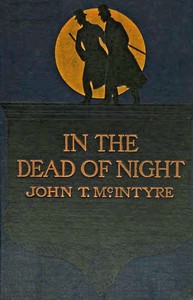
In the Dead of Night — Story, Setting & Ideas
Edition facts
The catalog record for In the Dead of Night — Story, Setting & Ideas provides practical reading context through 61,979 words, 4 hr 30 min estimated reading time, and 30 detected text sections.
The text analysis averages about 13.9 words per sentence, while the detected sections provide another way to judge how the source is divided.
Project Gutenberg metadata also associates the work with “New York (N.Y.) -- Fiction,” connecting these edition facts with the source record’s subject description.
Calculated from edition completeness, EPUB availability, text structure and catalogue metadata. Not a user rating.
How this score is calculated
- Description quality20 pts
- Title & short description10 pts
- Source metadata20 pts
- Text length15 pts
- Chapters / structure15 pts
- EPUB file integrity20 pts
Total of 100 points, scaled to a 2.5-5.0 range. Editions with an empty description or a missing EPUB file are not scored.
Read the Text
“The human mind,” he muttered, “can scarcely grasp the meaning of such a sum. And for one man to possess it all makes me suspect that something is out of kelter with our system of doing things. Here I am broke, and with the prospect of a succession of dinnerless days before me; and then here is another fellow with tons of money and no one to give it to. If I had the running of things I’d take down the bars on some of the fat pasture-land and let the lean cattle do a little private grazing.”
Upon the opposite side of Broadway a hansom was drawn up at the curb. Kenyon’s eyes rested absently upon the veiled woman who sat within it. He saw her speak a few hasty words to the driver; then he noted the man’s quick glance in his direction, and the smart swish of the long whip over the roof of the vehicle. The hansom rattled across the street and drew up beside him; the woman leaned forward.
“I was beginning to think that you had failed us,” she said.
A whimsical look came into Kenyon’s eyes; then he smiled good-naturedly.
“I beg your pardon,” he began; but she interrupted him.
“It is quite unnecessary,” she said. He noted that the tone and the gesture that accompanied the words were rather cold and imperious. “I suppose,” she continued, “that you did not know that he was ill; but, even so, you should not have delayed. However, it is not yet too late. The physicians have assured us that he will live until morning--that he may even get well.”
The whimsical look left Kenyon’s eyes and with it went the smile.
“Has there not been a mistake?” he asked, gravely. But she gestured impatiently.
“The physicians are the best in New York.”
Notwithstanding the coldness of the tone, there was a certain sweetness in the voice that attracted Kenyon; that she was a woman of gentle breeding was very evident. And then she was young!
Regretfully, he was about to inform her that he was not the person she thought him to be--that he was a stranger in New York--that he did not know a soul among its four millions. But she stopped him once more.
“The others are already there.” She made room for him beside her, as she spoke. “Will you get in? The matter must be adjusted quickly if at all.”
He noticed a quick flash of something like indignation in this last sentence, and smiled. She caught this and instantly her head went up like that of an offended queen.
“I will take this occasion to say,” she said, freezingly, “that I have considered his safety, alone, from the beginning. My own feelings do not enter into the matter.”
“I ask your pardon, again,” began the young man. “But the fact is--”
The small white hand went up once more and waved back the words.
“I repeat,” she said, “that you are still in time. However, it would have been much better if you had come earlier. The ship reached port some seven or eight hours ago; and there could have been nothing to detain you.”
Kenyon bent his brows, and looked puzzled.
“What ship do you refer to?” he asked.
“The _Blenheim_,” came the prompt answer. Her eyes were searching his face intently; even the thick veil could not hide the fact that they were big, dark, and lustrous. “That was the ship, was it not?”
“It was,” answered Kenyon, and the puzzled look grew deeper.
“He is very low,” the girl continued, “and he is very anxious to see you.”
A number of people stood about. Those who overheard were beginning to stare; and as this could not be endured, Kenyon entered the hansom. Instantly the driver called to his horse; the vehicle went rattling along Thirty-sixth Street, heading east, and Kenyon settled back by the girl’s side, smiling his astonishment into the darkness.
THE DARK HOUSE IN SELDEN’S SQUARE
“When strange eyes peer through the veiling dark, Take care, my friend, take care!”
--_From the Doggerels of Balmacenso._
IT was Kenyon’s idea, upon entering the cab, to afford himself an opportunity, out of earshot of the idlers, of bringing this bizarre situation to an end. But as before the girl gave him no chance.
“When you left Rio,” she began, in a rather hesitating way, “you had but little money, I understand.”
From its first paragraph, In the Dead of Night establishes a narrator who watches Broadway with amused detachment: “the same cocksureness, the same air of being the goal of all human effort.” Kenyon, the protagonist, eats a German dinner at the Berlin while an orchestra plays “one of those Indian things, filled with the throb of tom-toms.” The voice is wry, observant, and unhurried—yet the pace tightens as soon as a girl appears on a staircase, whispering his name with “sudden fear.”
McIntyre builds suspense through small, precise details: a hand darting over a shoulder, a tightening at the corners of a smile, a staircase with “many turns” and “many landings.” The language shifts from leisurely description to clipped, urgent sentences as Kenyon moves from dining room to hallway to stairway. This alternation between relaxed observation and quickened action defines the novel’s rhythm.
A Voice That Watches and Winks
The narrative voice in In the Dead of Night is consistently amused, even when describing danger. Kenyon’s internal commentary—calling Broadway “flippant and as garish as a vaudeville,” or noting that “social affairs always have an attraction for me”—creates a tone of dry irony. This voice does not simply report events; it judges them, often with a wink. When Kenyon finds himself unexpectedly face-to-face with Anna, he masks his surprise with a polished smile: “Ah, how do you do? I’m charmed, I’m sure.” The dialogue is similarly layered: Anna’s words seem innocent, but Kenyon suspects “a tightening at the corners of her mouth.” The narrator invites the reader to share Kenyon’s skepticism, making every exchange a puzzle.
Pace Shifts: From Stillness to Sudden Movement
McIntyre controls pace by alternating static observation with bursts of action. Early scenes linger on sensory details: the “throb of tom-toms,” the “massive balustrades and newel posts,” the “laughing chatter of a great number of women.” Then, without warning, the prose contracts. Kenyon hears “the rustle of silken skirts above him”; he turns “swiftly.” A whisper cuts through the noise. The staircase scene exemplifies this: paragraphs of careful description give way to a single, tense exchange. Later, when Kenyon decides to search the house, the sentences shorten: “He looked out into the hall… in an instant he had gained the stairway.” The effect is cinematic, drawing the reader from calm into alertness.
Recurring Details: Hands, Stairs, and Glances
Three motifs recur in the excerpts: hands, staircases, and fixed gazes. The frontispiece caption reads “A Small White Hand Darted over His Shoulder,” and in the text, Anna lays her hand on Kenyon’s shoulder. Staircases appear repeatedly—the “solid, hard-wood staircase, very wide, with massive balustrades” in Farbush’s house, and the stairs where Anna invites Kenyon to sit “like a schoolgirl.” These spaces become sites of encounter and concealment. Glances are equally telling: Anna’s “gaze was fixed upon the two” in one illustration caption; Kenyon’s “keen eyes” search faces for deception. These small, repeated gestures build a vocabulary of suspicion, suggesting that nothing—not a hand, not a stair, not a look—is innocent.
Readers will find that In the Dead of Night rewards attention to its narrative voice, which oscillates between amused commentary and taut observation. The novel’s structure—a series of nights, each denser with wonder—mirrors Kenyon’s gradual descent into a maze. Pay close attention to what characters do not say, and to the spaces between paragraphs: the pace shifts there, in the silences and sudden movements.
I kept thinking about that November night, how Kenyon drifts through a city that barely looks back. It’s the quiet accumulating dread, not the noise, that stays with you. Reading Against the Tide — Reading Notes felt like sitting with someone who noticed the same kind of shadows, slowly, without ever raising their voice.

There are no reviews for this eBook.
What did you think of this book?
Answer a few questions and save a private reflection on this device.