About 270 minutes
In the Dead of Night — Story, Setting & Ideas
Historical Psychological Social Fiction
61,979 recorded words. 5 minutes difference from this book's estimate.
View Gutenberg source #67900
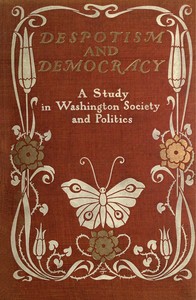
This digital edition of Despotism and Democracy: A Study in Washington Society and Politics — Story, Setting & Ideas is described by source-level measurements including 63,167 words, 4 hr 35 min estimated reading time, and 16 detected text sections.
The text analysis averages about 21.3 words per sentence, while the detected sections provide another way to judge how the source is divided.
Project Gutenberg metadata also associates the work with “Political fiction,” connecting these edition facts with the source record’s subject description.
Explore this collection
These alternatives are selected using recorded categories and estimated reading time.
About 270 minutes
Historical Psychological Social Fiction
61,979 recorded words. 5 minutes difference from this book's estimate.
View Gutenberg source #67900About 287 minutes
Historical Psychological Social Fiction
65,873 recorded words. 12 minutes difference from this book's estimate.
View Gutenberg source #68334About 259 minutes
Historical Psychological Social Fiction
59,417 recorded words. 16 minutes difference from this book's estimate.
View Gutenberg source #67531Search stored excerpts and compare books → Choose by your preferences →
Choices use stored catalog measurements. Estimates vary with reading speed. A shared category is a catalog label, not a claim that two books have the same argument or literary quality.
Search reads excerpt text stored with this catalog and links to its associated Gutenberg record. The connection is stored in the site database; this tool does not recheck that every excerpt is word-for-word identical to that external record. Excerpt search does not cover every chapter and does not verify historical publication dates.
Catalog snapshot checked: 2026-09-26. Coverage: 95 public books, 95 available source excerpts.
Calculated from edition completeness, EPUB availability, text structure and catalogue metadata. Not a user rating.
Total of 100 points, scaled to a 2.5-5.0 range. Editions with an empty description or a missing EPUB file are not scored.
Public-domain source text
The source text is kept in the dedicated reader, separate from this catalogue record and its commentary.
Molly Elliot Seawell opens Despotism and Democracy with a comparison of Washington to Paris on a wet night, immediately establishing a tone of social observation. The first chapter, “Men and Women,” introduces two congressmen—Geoffrey Thorndyke and Julian Crane—whose contrasting backgrounds (Eastern establishment vs. Middle West ambition) set up a central dynamic. The narrative voice is detached and ironic, noting that Crane’s social ambition is “primitive” and that he enjoys society “as the Indian gets out of his pow-wows.” This early detail signals that the novel will scrutinize the rituals of Washington life as much as its political maneuvering.
The excerpts reveal a keen attention to the gradations of Washington society. Seawell describes how ladies measure status by the era when their families emerged from having “help” to having servants, or changed their dinner hour from two to eight o’clock. This precise social coding is not merely background; it drives the plot. Constance Maitland’s report of the Guild for Superannuated Governesses meeting shows how charitable events become arenas for status competition. Mrs. Hill-Smith, representing families of “1860,” resists newer wealth from “1870.” The novel’s catalog subjects—political fiction and Washington fiction—are thus grounded in a specific social ecosystem where politics and society are inseparable.
Seawell intertwines political and personal motives. Thorndyke’s hope that “the majority in the lower House would not… make fools of themselves” is a partisan wish, but it is expressed during a private conversation with Constance, who “womanlike, never could be made to really understand the game of politics.” This gendered observation reflects the novel’s interest in how women navigate political circles. Crane’s social climbing is tied to his political rise; his apartment in a “modish hotel” costs more than he can afford. The excerpts do not reveal the plot’s outcome, but they establish that ambition—both social and political—is a central engine, and that the novel treats it with a mixture of sympathy and satire.
The narrator frequently steps back to comment on characters’ self-deceptions. Mrs. Baldwin “hugged the delusion that the others did not know about them,” while Constance alone “fathomed the nature of this misunderstood woman.” This ironic omniscience is a consistent feature of the excerpts. The prose is precise and sometimes aphoristic, as when Seawell compares a victoria ride to sitting in a theatre-box. Such comparisons elevate social observation into commentary. The novel’s structure—with chapter titles like “A Rapturous Hour which was Rudely Interrupted” and “There are Men who can Resist Everything except Temptation”—suggests a knowing, almost theatrical framing of events, reinforcing the idea that Washington society is itself a performance.
Readers approaching Despotism and Democracy should attend to the interplay between its political and social registers. The excerpts suggest that Seawell uses the setting of Washington not merely as a backdrop but as a lens through which to examine ambition, class, and gender. The novel’s ironic tone rewards careful reading of its social details—the price of tickets, the timing of dinners, the origins of families. These are not incidental but central to the work’s critique of the democratic ideal in a stratified society.
Reading about Seawell’s Washington, where ambition wears a polished smile, I remembered my grandfather’s stories of polite backrooms. He’d shake his head, saying rules were for show. That same quiet ache surfaced in Shaming the Speed Limit — Context and Discussion, which made me think of speed limits as just another velvet-gloved negotiation between what we claim and what we do. Some books simply hold up a mirror. I put both down, feeling oddly seen.
Your answers remain private and are stored only in this browser.