About 337 minutes
The sporting chance — Themes and Context
Historical Psychological Social Fiction
77,357 recorded words. 8 minutes difference from this book's estimate.
View Gutenberg source #68678
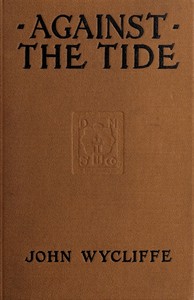
This digital edition of Against the Tide — Reading Notes is described by source-level measurements including 75,662 words, 5 hr 29 min estimated reading time, and 7 detected text sections.
The text analysis averages about 12.2 words per sentence, while the detected sections provide another way to judge how the source is divided.
Project Gutenberg metadata also associates the work with “New York (N.Y.) -- Fiction,” connecting these edition facts with the source record’s subject description.
Explore this collection
These alternatives are selected using recorded categories and estimated reading time.
About 337 minutes
Historical Psychological Social Fiction
77,357 recorded words. 8 minutes difference from this book's estimate.
View Gutenberg source #68678About 340 minutes
Historical Psychological Social Fiction
77,988 recorded words. 11 minutes difference from this book's estimate.
View Gutenberg source #67611About 341 minutes
Historical Psychological Social Fiction
78,382 recorded words. 12 minutes difference from this book's estimate.
View Gutenberg source #69105Search stored excerpts and compare books → Choose by your preferences →
Choices use stored catalog measurements. Estimates vary with reading speed. A shared category is a catalog label, not a claim that two books have the same argument or literary quality.
Search reads excerpt text stored with this catalog and links to its associated Gutenberg record. The connection is stored in the site database; this tool does not recheck that every excerpt is word-for-word identical to that external record. Excerpt search does not cover every chapter and does not verify historical publication dates.
Catalog snapshot checked: 2026-09-26. Coverage: 95 public books, 95 available source excerpts.
Calculated from edition completeness, EPUB availability, text structure and catalogue metadata. Not a user rating.
Total of 100 points, scaled to a 2.5-5.0 range. Editions with an empty description or a missing EPUB file are not scored.
Public-domain source text
The source text is kept in the dedicated reader, separate from this catalogue record and its commentary.
From its first sentence, Against the Tide establishes a world where surfaces are deliberately misleading. The Deming mansion is “ablaze with light from cellar to attic,” yet the morning is “deeply gloomy and ominous”—a juxtaposition that recurs throughout the excerpts. Bedford-Jones (writing as John Wycliffe) uses weather and illumination not as mere atmosphere but as a structural device: the thunderclouds over the Ohio mirror the hidden tensions within the wedding party, while the electric clusters and crystal prisms suggest a brittle, artificial brightness that cannot dispel the coming storm.
The author’s ear for speech is immediately evident in the wedding scene. He contrasts “crisply concise northern speech” with “the softer slur of southern accents,” positioning Evansville as a border city that “drinks of its best from either section.” This is not idle description; it establishes a linguistic fault line that will later fracture along class and moral lines. When Dorothy’s mother, Mrs. Deming, speaks of her husband’s loss of the company, her tone is “perfectly casual,” yet her words carry a weight that Dorothy finds “terrible because so innocent.” Bedford-Jones trusts the reader to hear the difference between what is said and what is meant—a technique he sustains through Slosson’s evasive “let the dead bury their dead” and Armstrong’s buoyant, businesslike chatter.
Dorothy’s internal state is rendered through a series of physical and spatial cues. She is led to a “window-nook” to hear Macgowan’s praise of Armstrong, a semi-private space that foreshadows the half-truths she will later inhabit. The narrative voice shifts fluidly between external observation and Dorothy’s mounting unease: “Upon her spirit settled the old haunting terror, with the clear-cut vividness of some horrible dream.” Bedford-Jones avoids direct psychological exposition, instead letting the reader infer her turmoil from her searching glances and her inability to speak. The repeated phrase “suspicion—of her husband!” is set off by dashes, mimicking the staccato rhythm of a mind recoiling from its own conclusions.
Material details carry narrative weight. The “scarlet coats of tapestried huntsmen, pursuing stags through indefinite forests of Gobelin weave” are not decorative; they evoke a world of pursuit and hidden violence. The Deming mansion itself, with its “twelve-foot ceilings” and “tinkling prisms,” becomes a character—a relic of past prosperity that now houses a wedding shadowed by financial loss. When Mrs. Deming mentions the house will be “in dreadful shape” during their European trip, the remark seems trivial, but it echoes the larger decay of the family’s fortunes. Bedford-Jones uses these objects to ground abstract anxieties in tangible, often domestic, settings.
The excerpts are structured around what is not said. Macgowan’s earlier words to Dorothy are never fully quoted; we only learn that they were “malicious” and that she seized on them “with an avid, fierce exultancy.” The exact nature of the “change of management” at Food Products remains opaque, filtered through Dorothy’s incomplete understanding. Bedford-Jones withholds the full backstory, forcing the reader to share Dorothy’s uncertainty. This technique creates a tension that is never fully resolved in the provided text—a deliberate choice that mirrors the novel’s title: the tide of suspicion rises even as the characters struggle against it.
Readers approaching Against the Tide should attend to the spaces between lines—the half-finished sentences, the glances exchanged, the objects that seem to carry more meaning than their owners admit. Bedford-Jones builds his drama not through action but through the slow accumulation of doubt, and the excerpts suggest a novel that rewards careful attention to voice and setting. The full work may clarify or complicate the suspicions planted here; the evidence alone points to a writer in firm control of his craft.
There’s something about how Bedford-Jones lets suspicion creep in slowly, through silence and small gestures. It reminded me of another story where what isn’t said carries the weight. The coming — Inside the Classic stayed with me the same way, that quiet unease lingering long after the pages close.
Save your reaction, strongest insight, and memorable passage.