1

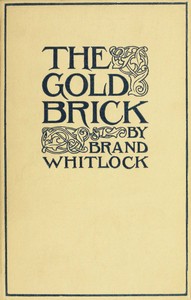
The Gold Brick — Context and Discussion
(7 User reviews)
1983
Project Gutenberg
2022
Not confirmed
Short stories, American; Political fiction; United States -- Politics and government -- Fiction
Readers of public-domain and historical texts
Project Gutenberg digital edition
en
Edition facts
Words
70,472
Reading time
307 min
Text sections
17
This digital edition of The Gold Brick — Context and Discussion is described by source-level measurements including 70,472 words, 5 hr 7 min estimated reading time, and 17 detected text sections.
The text analysis averages about 19.2 words per sentence, while the detected sections provide another way to judge how the source is divided.
Project Gutenberg metadata also associates the work with “Short stories, American,” connecting these edition facts with the source record’s subject description.
Source:
Project Gutenberg record #67596
Brand Whitlock's 1910 collection of twelve stories set in Ohio politics and journalism, following cartoonist Neil Kittrell's sudden wealth and state officials' financial crises, with sharp dialogue and ironic twists.
Editorial Edition Score
4.8/5
★★★★★
★★★★★
Calculated from edition completeness, EPUB availability, text structure and catalogue metadata. Not a user rating.
How this score is calculated
- Description quality20 pts
- Title & short description10 pts
- Source metadata20 pts
- Text length15 pts
- Chapters / structure15 pts
- EPUB file integrity20 pts
Total of 100 points, scaled to a 2.5-5.0 range. Editions with an empty description or a missing EPUB file are not scored.
Edition quality
Read the Text
mpressed and delighted as you hoped to find me, it is because I was thinking of Mr. Hardy and the poor, dear, common little _Post_, and then--of Mr. Clayton. Did you think of him?”
“You’ll have to--to cartoon him?”
The fact he had not allowed himself to face was close to both of them, and the subject was dropped until, just as he was going down-town--this time to break the news to Hardy--he went into the room he sarcastically said he might begin to call his studio, now that he was getting ten thousand a year, to look for a sketch he had promised Nolan for the sporting page. And there on his drawing-board was an unfinished cartoon, a drawing of the strong face of John Clayton. He had begun it a few days before to use on the occasion of Clayton’s renomination. It had been a labor of love, and Kittrell suddenly realized how good it was. He had put into it all of his belief in Clayton, all of his devotion to the cause for which Clayton toiled and sacrificed, and in the simple lines he experienced the artist’s ineffable felicity; he had shown how good, how noble, how true a man Clayton was. All at once he realized the sensation the cartoon would produce, how it would delight and hearten Clayton’s followers, how it would please Hardy, and how it would touch Clayton. It would be a tribute to the man and the friendship, but now a tribute broken, unfinished. Kittrell gazed a moment longer, and in that moment Edith came.
“The dear, beautiful soul!” she exclaimed softly. “Neil, it is wonderful. It is not a cartoon; it is a portrait. It shows what you might do with a brush.”
Kittrell could not speak, and he turned the drawing-board to the wall.
When he had gone, Edith sat and thought--of Neil, of the new position, of Clayton. He had loved Neil, and been so proud of his work; he had shown a frank, naïve pleasure in the cartoons Neil had made of him. That last time he was there, thought Edith, he had said that without Neil the “good old cause,” as he called it, using Whitman’s phrase, could never have triumphed in that town. And now, would he come again? Would he ever stand in that room and, with his big, hearty laugh, clasp an arm around Neil’s shoulder, or speak of her in his good, friendly way as “the little woman?” Would he come now, in the terrible days of the approaching campaign, for rest and sympathy--come as he used to come in other campaigns, worn and weary from all the brutal opposition, the vilification and abuse and mud-slinging? She closed her eyes. She could not think that far.
Kittrell found the task of telling Hardy just as difficult as he expected it to be, but by some mercy it did not last long. Explanation had not been necessary; he had only to make the first hesitating approaches, and Hardy understood. Hardy was, in a way, hurt; Kittrell saw that, and rushed to his own defense:
“I hate to go, old man. I don’t like it a little bit--but, you know, business is business, and we need the money.”
He even tried to laugh as he advanced this last conclusive reason, and Hardy, for all he showed in voice or phrase, may have agreed with him.
“It’s all right, Kit,” he said. “I’m sorry; I wish we could pay you more, but--well, good luck.”
That was all. Kittrell gathered up the few articles he had at the office, gave Nolan his sketch, bade the boys good-by--bade them good-by as if he were going on a long journey, never to see them more--and then he went.
Neil Kittrell, a cartoonist for the Morning Telegraph, learns he will earn ten thousand dollars a year and immediately buys an azalea for his wife Edith. The February streets turn gold in his perception, and he adopts the expression of ennui appropriate to Claybourne Avenue. Whitlock establishes a protagonist whose sudden prosperity alters his view of the world, yet the story quickly pivots to the political machinery of an unnamed state capital.
The excerpts reveal a collection that moves between personal fortune and public corruption. In a later story, Attorney-General Grigsby frantically seeks help after the state treasurer dies, leaving a deficit he must cover that night. The dialogue between Grigsby and Secretary of State Jennings is taut with desperation and old grudges, hinting at a network of favors and betrayals that will shape the narratives.
From Cartoonist to Capital Insider
The opening story introduces Kittrell as an artist turned cartoonist, a man who tried to make an artist of himself but was shaped by fate or economic determinism. His sudden salary jump—ten thousand a year—is the gold brick of the title, a promise that may prove hollow. Whitlock uses Kittrell’s perspective to satirize social climbing: he buys daffodils because a shopgirl calls yellow a “spirituelle color,” then upgrades to an azalea, and rides a cab with practiced ennui. The reader should note how quickly Kittrell’s thoughts turn to whether Edith will now prefer Claybourne Avenue, the fashionable district. This early attention to status and appearance sets a pattern for the collection.
The Language of Political Desperation
In the second excerpt, Attorney-General Grigsby and Secretary of State Jennings speak in a vernacular that marks them as insiders. Grigsby’s panic is palpable: “it’s got to be done now, to-night, or I’m lost.” Jennings responds with a drawl—“Hev you got any money?”—and a pragmatic willingness to help. Their exchange reveals a code of loyalty and mutual dependence. Grigsby refuses to approach Governor Chatham, whom he once befriended, because he fears being thrown over. Jennings reminds him that Grigsby himself was once a reformer, a jab that colors their history. The dialogue carries the weight of past betrayals and unspoken debts, and readers should attend to the rhythm of accusation and reluctant aid.
A Treasury Crisis and a Secret Loan
The crisis hinges on a state treasury that must be sealed immediately after the treasurer’s death. Grigsby has borrowed money from the treasury, and Governor Chatham—under the law—will act at once. Jennings offers to lend Grigsby twenty-four thousand dollars, fees from his own office, deposited in a Decatur bank. The sum is specific, the timing urgent. Whitlock does not explain the legal mechanism, but the scene conveys the fragility of political finance. The reader is left to infer that Grigsby’s debt is a secret that could destroy him. The story’s title, “The Gold Brick,” may refer not only to Kittrell’s salary but to the illusory solidity of political fortunes.
Recurring Motifs and Structural Hints
Across the excerpts, Whitlock employs several recurring elements: the sudden reversal of fortune (Kittrell’s raise, Grigsby’s fall), the importance of a single night’s action, and the tension between personal loyalty and political survival. The settings shift from a newspaper office to a cab ride to a private conference, but the tone remains ironic and unsentimental. The table of contents lists twelve stories, including “The Has-Been,” “Macochee’s First Campaign Fund,” and “The Pardon of Thomas Whalen,” which suggest further explorations of political machines, reform movements, and individual compromise. Readers should watch for how Whitlock varies the point of view—from a cartoonist to a governor to a ward heeler—while maintaining a consistent satirical edge.
Whitlock, a former mayor of Toledo and a reform politician himself, writes from inside knowledge. The stories originally appeared in The Saturday Evening Post and The American Magazine, venues that favored political fiction with a progressive slant. As you read, note how the author balances sympathy for his characters with a clear-eyed view of their self-deceptions. The gold brick may be a bribe, a salary, or a promise—each story tests what it is worth.
I’ve often thought how The Gold Brick trails its characters through sudden ruin, the quiet unraveling of a life held too tightly. It reminds me of Their Child — Key Ideas to Explore, which lingers on what remains when fortunes shift. Both seem to know that money never shelters the heart, only tests it.
Matthew Robinson
2 weeks ago-

Larry Bush - 1 month ago
The Gold Brick is a slog to get through. The story is predictable, and the characters fall flat, especially the supporting cast. The prose is heavy-handed and lacks subtlety. It reads like a generic western with none of the charm or excitement. I struggled to finish it, and by the end, I didn't care what happened to anyone. -
Mariah Gallagher - 1 month ago
The Gold Brick is a riveting historical tale that immerses you in the gritty world of fortune seekers. The author's meticulous research brings the era to life, and the protagonist's relentless pursuit of wealth is both thrilling and morally complex. The plot twists are well-executed, keeping me on the edge of my seat until the final page. A masterful blend of adventure and character study that lingers long after you finish. -
Ryan Randy Mccall - 3 weeks ago
The Gold Brick offers a compelling glimpse into the gold rush era, with vivid descriptions and a solid plot. However, the pacing stumbles in the middle, with some sections dragging. The characters are engaging, but the antagonist feels a bit one-dimensional. It's an enjoyable read for historical fiction fans, but it just misses being great.
Reader reflection
How will you remember this book?
Save your reaction, strongest insight, and memorable passage.
Your progress
0
/
10
2
How much did you enjoy the reading experience?
3
Would you recommend this book to another reader?
4
How demanding did the text feel?
5
How clear did the writing feel?
6
How did the pace of the book feel?
7
Would you like to discuss this book with someone?
8
How personally connected did you feel to the book?
9
What is the main idea you are taking away?
10
Sebastian Thomas
1 month ago