About 206 minutes
The bushwhackers & other stories — Story, Setting & Ideas
Historical Psychological Social Fiction
47,267 recorded words. 4 minutes difference from this book's estimate.
View Gutenberg source #68162
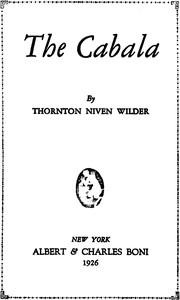
The catalog record for The Cabala — Story, Setting & Ideas provides practical reading context through 46,347 words, 3 hr 22 min estimated reading time, and 4 detected text sections.
The text analysis averages about 17.5 words per sentence, while the detected sections provide another way to judge how the source is divided.
Project Gutenberg metadata also associates the work with “Upper class -- Fiction,” connecting these edition facts with the source record’s subject description.
Explore this collection
These alternatives are selected using recorded categories and estimated reading time.
About 206 minutes
Historical Psychological Social Fiction
47,267 recorded words. 4 minutes difference from this book's estimate.
View Gutenberg source #68162About 180 minutes
Historical Psychological Social Fiction
41,319 recorded words. 22 minutes difference from this book's estimate.
View Gutenberg source #67606About 179 minutes
Historical Psychological Social Fiction
40,963 recorded words. 23 minutes difference from this book's estimate.
View Gutenberg source #67669Search stored excerpts and compare books → Choose by your preferences →
Choices use stored catalog measurements. Estimates vary with reading speed. A shared category is a catalog label, not a claim that two books have the same argument or literary quality.
Search reads excerpt text stored with this catalog and links to its associated Gutenberg record. The connection is stored in the site database; this tool does not recheck that every excerpt is word-for-word identical to that external record. Excerpt search does not cover every chapter and does not verify historical publication dates.
Catalog snapshot checked: 2026-09-26. Coverage: 95 public books, 95 available source excerpts.
Calculated from edition completeness, EPUB availability, text structure and catalogue metadata. Not a user rating.
Total of 100 points, scaled to a 2.5-5.0 range. Editions with an empty description or a missing EPUB file are not scored.
Public-domain source text
The source text is kept in the dedicated reader, separate from this catalogue record and its commentary.
The novel opens not in Rome but on a cold, overcrowded train crossing the Campagna, where the narrator observes a microcosm of travelers: tourists fleeing imagined cholera, returning Italian-Americans whose Americanization has coarsened them, and a glittering-eyed matron guarding her husband. This scene establishes Wilder's eye for social contrast and his willingness to let a single journey introduce themes of displacement, class, and the gap between expectation and reality. The narrator's remark that Virgil's land 'receives its sentiment from him' signals the book's interest in how literature and memory shape experience.
The titular Cabala is a group of Roman aristocrats who govern social life through unwritten rules. Wilder presents them not as villains but as figures bound by their own intricate etiquette. The narrator notes that for them, 'worldly propriety had ceased to exist'—they operate instead by an inner, spiritual propriety that outsiders can barely perceive. This is evident in the Princess Alix's obsessive love for the scholar Blair: she counts days between meetings, gauges the 'spiritual propriety' of contact, and interprets chance encounters as proof of guardian angels. Yet her intensity repels him; he sees her first as an enemy to his studies, then as 'that strange hedged monster which all his wide reading had not been able to humanize: a married woman.' The Cabala's codes thus produce both exquisite devotion and brutal isolation.
The narrator occupies a liminal position: he is enough of an insider to witness the Cabala's dramas, but enough of an outsider to analyze them. His voice shifts between detached irony and genuine involvement, as when he mediates between Alix and Blair. He becomes angry with Blair, analyzing 'the different kinds of fool he was,' and insists that being loved places one under 'an obligation to be grateful.' Yet he also withholds information from Alix, colluding in Blair's secret departure. This dual role mirrors the novel's broader tension between American directness and European indirection. The narrator's observations are precise—he notes the 'bulbous features' and 'barbarous idioms' of returning emigrants—but his own motives remain partly opaque, suggesting that even the most perceptive outsider cannot fully decode the Cabala.
Wilder repeatedly invokes Virgil, Fabre, and other classical and literary references, not as decoration but as active forces in the characters' lives. The narrator feels Virgil's presence in the wind across the Campagna; Alix's love for Blair is partly a response to his scholarly immersion in 'the great ladies of his study.' Yet these references also create distance: Blair hides behind his work, using it as a shield against Alix's emotion. The novel suggests that literature can both illuminate and obstruct human connection. When Blair gives Alix a book, she misreads it as a sign of intimacy, pushing for 'almost daily meetings' and 'long comradely lazy afternoons.' The gift becomes a trap, revealing how easily cultural capital can be mistaken for personal feeling. Wilder's prose itself enacts this tension, blending lyrical description with clinical psychological observation.
Throughout the excerpts, characters orbit each other in patterns of pursuit and flight. Alix's love is a 'cavern of horror'—she seems always to love those who do not love her. Blair, in turn, becomes 'bewildered, revolted, enraged,' clinging to side streets to avoid her. Their dynamic is choreographed with almost architectural precision: she climbs his stairs, he hides behind the door; she calls, the bell rings 'with a menacing sound.' The narrator's apartment becomes a neutral ground where these forces briefly meet, but even there, Blair consents to dinner only on condition that his departure remain secret. Wilder maps these emotional geometries with a coolness that heightens their pathos. The result is a novel less about Rome than about the spaces—physical, social, psychological—that people build to contain or escape each other.
Readers will find that The Cabala rewards attention to its minor characters and offhand details: the adventuress in silver sables, the glittering-eyed matron, the returning emigrants. These figures, glimpsed only briefly, echo the main drama in miniature. Wilder's prose demands patience—his sentences are long, his ironies understated—but the novel's emotional architecture is precise. Watch how the narrator's own role shifts: he is both confidant and manipulator, sympathetic and opaque. The Cabala itself remains partly mysterious, a fitting quality for a book about the limits of understanding.
Wilder’s Rome felt like a place where conversation was armor, and the Victorian satirists knew that armor too—just worn heavier, with more brocade. I keep thinking of the Cabala’s brittle wit, then returning to those older novels’ sharper, sadder laughs. There’s a quiet ache in both, as if everyone’s hiding something. Satire in the Victorian novel — Story, Setting & Ideas brings that feeling back.
Answer a few questions and save a private reflection on this device.