About 179 minutes
A Marriage in High Life, Volume I — Background and Themes
Historical Psychological Social Fiction
40,963 recorded words. 1 minutes difference from this book's estimate.
View Gutenberg source #67669
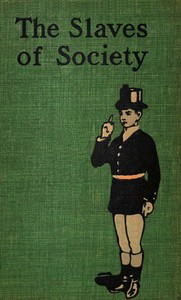
The source record for The Slaves of Society: A Comedy in Covers — Reading Notes measures this digital text at 41,319 words, 3 hr estimated reading time, and 18 detected text sections.
The text analysis averages about 13.3 words per sentence, while the detected sections provide another way to judge how the source is divided.
Project Gutenberg metadata also associates the work with “Satire,” connecting these edition facts with the source record’s subject description.
Explore this collection
These alternatives are selected using recorded categories and estimated reading time.
About 179 minutes
Historical Psychological Social Fiction
40,963 recorded words. 1 minutes difference from this book's estimate.
View Gutenberg source #67669About 202 minutes
Historical Psychological Social Fiction
46,347 recorded words. 22 minutes difference from this book's estimate.
View Gutenberg source #68105About 206 minutes
Historical Psychological Social Fiction
47,267 recorded words. 26 minutes difference from this book's estimate.
View Gutenberg source #68162Search stored excerpts and compare books → Choose by your preferences →
Choices use stored catalog measurements. Estimates vary with reading speed. A shared category is a catalog label, not a claim that two books have the same argument or literary quality.
Search reads excerpt text stored with this catalog and links to its associated Gutenberg record. The connection is stored in the site database; this tool does not recheck that every excerpt is word-for-word identical to that external record. Excerpt search does not cover every chapter and does not verify historical publication dates.
Catalog snapshot checked: 2026-09-26. Coverage: 95 public books, 95 available source excerpts.
Calculated from edition completeness, EPUB availability, text structure and catalogue metadata. Not a user rating.
Total of 100 points, scaled to a 2.5-5.0 range. Editions with an empty description or a missing EPUB file are not scored.
Public-domain source text
The source text is kept in the dedicated reader, separate from this catalogue record and its commentary.
The Marchioness of Severn, nibbling a three-cornered piece of muffin, opens the novel by sighing, “After all, what are we but slaves of society?” This line, spoken over a silver chafing-dish, sets the tone for a comedy that treats social rituals as both absurd and coercive. The scene is staged in a Berkeley Square drawing-room decorated with “Japanese dragons going through a kind of dragon drill” and a carpet compared to the poetical style of Robert Montgomery—a deliberately overwrought description that mocks the very luxury it catalogues. Upward’s narrator lingers on material details (a porcelain basin “of the thinness and transparency of a sea-shell”) to underscore how possessions become props in a performance of status. The opening thus establishes a world where every gesture, from a nibble to a sugar cube, is freighted with social calculation.
Mr. Despencer calls the marchioness “a bird of paradise held captive in a gilded cage,” a phrase she receives with ambiguous silence. The metaphor recurs when Belle Yorke, a music-hall singer, is warned by the marchioness that society has “very keen ears for the least whisper against a woman’s name.” Both women are confined by different rules: the marchioness by the need to maintain appearances, Belle by the threat of scandal that could lower her “connection with the music-halls.” The cage is not just a figure of speech; it is built into the architecture of the novel’s dialogue, where compliments double as threats and warnings masquerade as friendship. Upward’s satire lies in showing that the cage’s bars are made of words—polite, ambiguous, and wielded by those who claim to be fellow prisoners.
Chapter VII is titled “A Question of Chemistry,” a phrase that hints at the novel’s interest in the alchemy of class. In the excerpt, the marchioness explains to Belle that Mr. Hammond “moves in the very best society” and “could marry almost any woman in England, except royalty.” The word “chemistry” suggests a system of reactions: a millionaire’s wealth can transmute social standing, but a woman’s reputation is volatile. Belle’s retort—“Mr. Hammond’s attentions to me have always been perfectly respectful”—is met with the marchioness’s insistence that society “never believes that a man’s friendship for a woman is perfectly respectful.” The dialogue becomes a duel of subtext, where each speaker tries to control the other’s social valence. Upward uses the language of science to expose the arbitrary rules that govern who can rise and who must stay in place.
The subtitle “A Comedy in Covers” points to the novel’s preoccupation with surfaces—what is hidden, what is revealed, and what is performed. The marchioness’s smile “like a mother” as she delivers a veiled threat, Belle’s “carefully measured voice” that betrays “rising anger,” and the narrator’s description of a carpet with “rich but chaotic pattern” all emphasize the gap between appearance and intent. The cover of the book itself, with its title and author pseudonym (“The Man Who Heard Something”), reinforces this theme. Even the physical setting—a room so cluttered with “fantastic and inconvenient chairs” and “palms in Satsuma jars” that it would be hazardous for the gymnastic dragons—is a joke about the absurdity of decorating a cage. Upward’s comedy depends on the reader’s ability to see through the covers that his characters so carefully maintain.
Readers should attend to the novel’s chapter titles, which often undercut the scenes they introduce (e.g., “A Mother’s Cares” reveals a mother who is anything but caring). The dialogue rewards close attention to what is left unsaid—the pauses, the smiles, the “silence that had something satirical in it.” Upward’s satire is precise, not broad; it works through accumulation of detail rather than overt mockery. Approach the text as a performance in which every character is both actor and audience.
I was thinking today about the Marchioness’s drawing-room, those whisper-thin walls of English propriety, and how much was hidden in plain sight. It brought to mind a darker, quieter shadow of the same feeling. I found myself reaching for Our Lady of Darkness — Reading Companion, recalling how its rooms held their own kind of social ghosts. A curious echo, that.
Save your reaction, strongest insight, and memorable passage.