1

Cavalry Curt; Or, The Wizard Scout of the Army — Context and Discussion
(6 User reviews)
1655
Project Gutenberg
2022
Not confirmed
United States -- History -- Civil War, 1861-1865 -- Fiction; Dime novels
Readers of public-domain and historical texts
Project Gutenberg digital edition
en
Edition facts
Words
26,576
Reading time
116 min
Text sections
25
Before opening Cavalry Curt; Or, The Wizard Scout of the Army — Context and Discussion, the edition data offers a quick orientation: 26,576 words, 1 hr 56 min estimated reading time, and 25 detected text sections.
The text analysis averages about 12.2 words per sentence, while the detected sections provide another way to judge how the source is divided.
Project Gutenberg metadata also associates the work with “United States -- History -- Civil War, 1861-1865 -- Fiction,” connecting these edition facts with the source record’s subject description.
Source:
Project Gutenberg record #67404
This editorial note examines how the opening, middle, and later excerpts of G. Waldo Browne's 1892 dime novel guide a first reading, focusing on the protagonist's introduction, the spy's internal conflict, and the narrative's use of historical setting.
Editorial Edition Score
4.7/5
★★★★★
★★★★★
Calculated from edition completeness, EPUB availability, text structure and catalogue metadata. Not a user rating.
How this score is calculated
- Description quality20 pts
- Title & short description10 pts
- Source metadata20 pts
- Text length15 pts
- Chapters / structure15 pts
- EPUB file integrity20 pts
Total of 100 points, scaled to a 2.5-5.0 range. Editions with an empty description or a missing EPUB file are not scored.
Edition quality
Read the Text
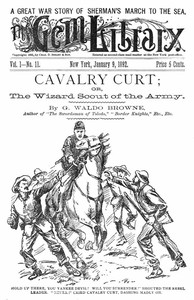
“Halt! who comes there?”
Time: Daybreak on the morning of May 6th, 1864.
Scene: A wild, broken area of country in northern Georgia.
Actors: In the foreground, a horseman and a drowsy sentinel roused to a sense of his duty by the sound of the approaching rider; in the background, a score or more of Confederate cavalry--men springing from their blankets at the warning of danger.
A rifle had sprung to the shoulder of the startled sentry, and the sharp click of a lock followed his ringing challenge.
The foam-flecked steed of the on-comer was hurled back upon its haunches by the iron hold laid upon its bit.
“Who comes there?” repeated the ominous tone of the man in gray.
“A friend to the loyal,” answered the horseman.
“Advance, friend, and give the countersign.”
As the single word left the stranger’s lips, he plunged the rowels deep into his horse’s quivering flank, when like an arrow shot from a bow he bounded forward.
The movement was so sudden that before the surprised sentry could discharge his weapon the rider was upon him.
The report of his rifle followed, but the bullet flew wide of its mark, and he was hurled to the earth.
“On, Wildbird, on!” cried the reckless rider, his words drowned by the sounds of his flying steed’s iron heel.
The amazed cavalrymen had gained their feet.
“Stop him, boys!” cried their leader. “’Tis one of Sherman’s scouts!”
The valley was narrow here.
Upon the right, looking south, rose abruptly the rugged heights.
On the left, a spur of the mountain range had a more gradual ascent.
The escaping horseman was forced to pause within a short distance of his enemies--so near in fact that his white face shone plainly in the starlight.
“Fire!” rang out the cavalry chief’s wild command.
A volley of bullets whistled around the fugitive’s head.
He was seen to reel in his saddle, but his flight was unchecked.
“S’ death! there he goes!” exclaimed the Confederate leader. “Quick! follow me!”
As one the twenty men sprang forward to intercept the fugitive’s flight.
Owing to a curve in the valley the horseman could not pursue a straight course.
Thus at the moment when his escape seemed certain he found his retreat cut off.
As yet he had not fired a shot.
His assailants were now so close upon him that his rifle was useless save as a club.
If he realized his hopeless situation he did not hesitate in his headlong course.
Like a Centaur he swept into the midst of his foes.
Some were hurled right and left.
The foremost seized the bridle of the plunging horse.
“Hold up there, you Yankee devil!”
“Never!” rang out the sharp retort, and the other was felled to the earth.
The path was blocked.
In vain the noble brute struggled to free himself.
Three of the sentinels were clinging to its bridle and the plunging steed was stopped.
Others of the assailants were trying to pull the rider from his seat.
A few shots were fired, but the fight had come to such close quarters that firearms were of little use.
The stranger’s rifle had been hurled from his grasp.
He felt himself borne down, and for a moment his struggles ceased.
“Will you surrender?” gritted the leader.
Suddenly, with a herculean effort, the horseman freed his right arm.
An instant later a knife flashed in his hand.
Descrying a circle in the air it descended with lightning-like rapidity, severing at a single stroke the horse’s bridle.
At the same time the assailants staggered back, leaving the wounded and maddened steed free.
With a snort of defiance it bounded forward sending the baffled men right and left.
Before they could rally, the dashing scout had cleared them.
A few shots were fired, but none seemed to take effect.
As their yells of rage rang on the air, the fugitive disappeared down the valley.
“That’s a pretty go!” muttered the leader of the discomfited gang. “I should rather have lost my right arm than that he should have escaped.”
“Did you recognize him, captain?” asked a tall, flaxened-hair soldier.
“He is Cavalry Curt.”
“Not Phil Kearney’s scout?”
“The same. I heard at headquarters yesterday that he was in these regions. His presence means us mischief.”
“And his escape something worse.”
“But he must not escape.”
“Quick, into the saddle. We must follow him.”
Three of the party were injured so that they could not join in the pursuit, and were forced to remain behind.
The others vaulted into the saddle and a few minutes later were following as rapidly as the country would permit on the trail of the fugitive.
The novel opens with a staged confrontation: a sentry's challenge, a countersign exchange, and a sudden dash. The line 'Hold up there, you Yankee devil!' establishes immediate tension, while the protagonist's horse, Wildbird, is named in the first chapter. The scene is set at daybreak on May 6, 1864, in northern Georgia, grounding the adventure in Sherman's campaign. The reader is thrust into action without preamble, learning character through movement rather than description.
A Protagonist Defined by Action
The opening chapter introduces Cavalry Curt through his actions: he charges past a sentry, escapes, and is later described as 'the reckless rider.' His horse, Wildbird, is given a personality, and Curt's dialogue is limited to commands like 'On, Wildbird, on!' The narrative prioritizes physical momentum over interiority. A first-time reader will notice that Curt's motivations are not explained; he is simply a Union scout in Confederate territory. The dime novel format relies on this kinetic introduction to hook the reader, with character traits emerging from how he handles danger.
The Spy's Double Consciousness
In the middle excerpt, Curt infiltrates a Confederate scouting party. The text reveals his internal conflict: he recognizes a voice from his past, a man who 'had at one time belonged to Kearney’s cavalry' but disappeared. Curt resolves to 'maintain a careful watch over himself,' suspecting the man has deserted. This moment of recognition creates dramatic irony—the reader knows Curt is a spy, but the other characters do not. The narrative shifts between Curt's external actions and his private calculations, offering a glimpse of the psychological strain beneath the adventure surface.
Historical Anchors and Narrative Pace
The novel weaves real Civil War events into its plot. The excerpts reference Sherman's advance, McPherson's attack on Reseca, and Johnston's defensive maneuvers. The text notes that 'the march to Reseca was performed with the ease and rapidity that marked the Confederate commander’s entire campaign.' These historical details serve as a backdrop for the fictional action, but the narrative does not pause to explain them. A first-time reader may need to infer the strategic context from passing mentions, as the story prioritizes the scout's immediate peril over historical exposition.
Voice and Vernacular in Dialogue
The dialogue in the excerpts is marked by colloquial speech and period slang. Confederate characters use phrases like 'I kalkilate' and 'foller me,' while Curt's countersign is the single word 'Freedom.' The sentry's challenge—'Halt! who comes there?'—is a formulaic military call, but the rebel leader's shout 'Hold up there, you Yankee devil!' injects a personal, antagonistic tone. These linguistic choices create a sense of immediacy and regional flavor, though the narrator's own voice remains formal and omniscient, occasionally addressing the reader directly ('Cavalry Curt, we remember').
Readers approaching this dime novel for the first time should pay attention to how Browne balances action with historical detail. The excerpts suggest a narrative that moves quickly, relying on recognizable Civil War settings to lend weight to the spy's adventures. Curt's internal thoughts, when they appear, offer a counterpoint to the external action. The novel rewards attention to small details—a horse's name, a countersign, a familiar voice—that build a layered portrait of a scout at war.
There’s a strange tenderness in watching Curt wrestle with his conscience amid the war’s noise—it reminds me how Browne’s era kept circling the same quiet questions. That old ache surfaces again in reading about Samantha’s own fumbling toward kindness. It’s a gentler echo, perhaps, but the wistfulness lingers. Samantha Among the Colored Folks: "My Ideas on the Race Problem" — A Reader’s Guide sits nearby on my shelf, and I find myself thinking of both books together, softly.
-

Katherine Ryan - 1 month ago
The premise is intriguing—combining espionage, wizardry, and the Old West—and the action sequences are genuinely exciting. However, the supernatural elements sometimes clash with the historical setting, and the prose, while competent, lacks the polish of more modern historical fiction. Still, it's an enjoyable, quick read for those seeking a unique genre blend. -
Stephanie Jessica Walker - 1 month ago
An exhilarating blend of military strategy and frontier magic! The protagonist, Curt, is a brilliantly crafted scout whose unconventional wizardry adds a fresh twist to Civil War-era adventures. The pacing is relentless, the battle scenes are vividly rendered, and the camaraderie between soldiers feels authentic. A must-read for fans of alternate history and heroic fantasy. I couldn't put it down! -
Molly Moore - 2 weeks ago
Despite an interesting concept, the execution falls flat. The characters are cardboard cutouts, and the dialogue is stilted. The magic system is never fully explained, making the wizardry feel arbitrary and cheap. The plot rambles, and the historical inaccuracies are distracting. I wanted to enjoy this, but it felt like a chore to finish. There are far better military fantasy novels out there.
Reader reflection
Your personal reading reflection
Build a private reading journal entry for this title.
Your progress
0
/
10
2
Did this book hold your interest?
3
Would you pass this book on to a friend?
4
What was the reading difficulty like?
5
How clear did the writing feel?
6
How would you rate its originality?
7
What was its emotional impact?
8
Did the book give you something worth debating?
9
In one sentence, what did you learn?
10
James Nelson
1 month ago