About 40 minutes
The Last Laugh — Reading Companion
Historical Psychological Social Fiction
9,172 recorded words. 13 minutes difference from this book's estimate.
View Gutenberg source #67070
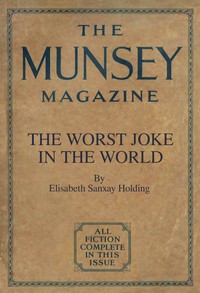
For The Worst Joke in the World — Background and Themes, the stored edition analysis reports 12,003 words, 53 min estimated reading time, and 2 detected text sections.
The text analysis averages about 15.4 words per sentence, while the detected sections provide another way to judge how the source is divided.
Project Gutenberg metadata also associates the work with “United States -- Social life and customs -- 20th century -- Fiction,” connecting these edition facts with the source record’s subject description.
Explore this collection
These alternatives are selected using recorded categories and estimated reading time.
About 40 minutes
Historical Psychological Social Fiction
9,172 recorded words. 13 minutes difference from this book's estimate.
View Gutenberg source #67070About 71 minutes
Historical Psychological Social Fiction
16,110 recorded words. 18 minutes difference from this book's estimate.
View Gutenberg source #65914About 81 minutes
Historical Psychological Social Fiction
18,488 recorded words. 28 minutes difference from this book's estimate.
View Gutenberg source #68088Search stored excerpts and compare books → Choose by your preferences →
Choices use stored catalog measurements. Estimates vary with reading speed. A shared category is a catalog label, not a claim that two books have the same argument or literary quality.
Search reads excerpt text stored with this catalog and links to its associated Gutenberg record. The connection is stored in the site database; this tool does not recheck that every excerpt is word-for-word identical to that external record. Excerpt search does not cover every chapter and does not verify historical publication dates.
Catalog snapshot checked: 2026-09-26. Coverage: 95 public books, 95 available source excerpts.
Calculated from edition completeness, EPUB availability, text structure and catalogue metadata. Not a user rating.
Total of 100 points, scaled to a 2.5-5.0 range. Editions with an empty description or a missing EPUB file are not scored.
Public-domain source text
The source text is kept in the dedicated reader, separate from this catalogue record and its commentary.
The story opens with Mrs. Champney packing a velvet kitten—a match-striker given by a grateful cook early in her marriage. The kitten is neither useful nor ornamental, yet it brings a sob to her throat. This small object anchors the narrative: it is a token of a past she cannot discuss, a period of her life she guards from her two elderly friends, Mrs. Maxwell and Mrs. Deane. The scene establishes a pattern of withheld emotion and selective memory that runs through the excerpts.
Holding’s prose is precise and understated. Mrs. Champney at fifty is seen as “girlish” by her friends, but the reader quickly senses a gap between her bright exterior and the weight of what she leaves unsaid. The opening room, stripped of its belongings, becomes a metaphor for a life being dismantled—or perhaps rearranged.
The velvet kitten is the story’s most concrete symbol. It is described as “precious” to Mrs. Champney, yet she cannot explain why to her friends. The narrator notes that she has talked freely about her “heavenly winters in Italy” and her girlhood, but “very, very little about the period to which the velvet kitten belonged.” This asymmetry is deliberate: the reader is given access to her inner life while the other characters are not. The kitten hung in the bedroom of a “shabby, sunny old house in Connecticut” where her children were born. That house is recalled without bitterness, but with a tenderness that makes her “laugh through the tears.” Holding uses the kitten to signal that the story’s emotional center lies not in the present action but in the layered past that Mrs. Champney carries with her.
Later in the excerpts, Mrs. Champney has moved to a suburban town near her son Robert and his wife Molly. She is about to start work at the Needlecraft Shop for eighteen dollars a week. The narrative shifts to her internal calculations: she can live independently, see the baby often, and be a “fairy godmother—with sadly clipped wings.” But the real tension is with Robert. She dreads telling him about her job. She considers taking “a mighty high hand with him from the start,” yet feels “depressed, and tired and—yes, crushed.” When she returns home, Robert meets her at the stairs with a look she has never seen before: “the profound compassion and tenderness of a man.” This moment undercuts her earlier view of him as a “dear and rather clumsy boy.” Holding shows a relationship in flux, where roles are being renegotiated without open conflict.
Mrs. Champney’s grandson Bobbetty, not yet three, is a vivid presence. He sits in his high chair, eating Graham crackers and milk, with a “sidelong glance” that suggests a “thoughtful and alarming gleam.” Mrs. Champney buys him a gray plush animal (she thinks it is a dog, the saleswoman a cat) and removes its pin eyes to prevent injury. Bobbetty receives it with “warm affection” and later, in his crib, chatters about “a wild horsy who stampled on six policemens.” The child’s personality is rendered with affectionate humor, but his presence also sharpens the story’s central dilemma: Mrs. Champney wants to be near him, yet must navigate her son’s authority. The scene of putting Bobbetty to bed—where she feels “quite ashamed” for interrupting his polite conversation—shows her tenderness and her awareness that she is no longer the primary caregiver.
Throughout the excerpts, Holding positions the reader as a confidant who knows more than the other characters. Mrs. Champney’s friends see only her “gayety” and “dainty clothes”; Robert sees a mother he must protect; Molly is a background figure. But the narrator reveals Mrs. Champney’s tears, her suppressed sobs, and her memories. This asymmetry creates a quiet tension: the reader waits for the moment when her inner life will break through the surface. The story’s title, “The Worst Joke in the World,” is never explained in the excerpts, but it hints at a painful irony—perhaps the joke is the gap between how Mrs. Champney is perceived and what she feels. The excerpts end before any resolution, leaving the reader to wonder whether she will tell Robert about her job, and whether the velvet kitten’s story will ever be shared.
Readers should attend to the small objects and gestures that carry emotional weight: the kitten, the plush animal, the broken chair from a memory. Holding’s style rewards patience; the story’s power lies in what is not said. Notice how Mrs. Champney’s voice shifts between the bright tone she uses with others and the private reflections the narrator shares. The excerpts offer a portrait of a woman at a threshold, and the title remains a riddle worth holding in mind.
Mrs. Champney’s velvet kitten, that small keepsake of unspoken duty, reminds me of how The Worst Joke in the World holds its grief in quiet corners. I sometimes shelve it beside The sporting chance — Themes and Context, for both know that chance often wears a tired, familiar face, and family love is rarely loud.
Your answers remain private and are stored only in this browser.