1

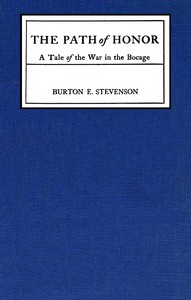
The path of honor: A tale of the war in the Bocage — Key Ideas to Explore
(8 User reviews)
1425
Project Gutenberg
2022
Not confirmed
France -- History -- Revolution, 1789-1799 -- Fiction; Love stories
Readers of public-domain and historical texts
Project Gutenberg digital edition
en
Edition facts
Words
78,382
Reading time
341 min
Text sections
42
This digital edition of The path of honor: A tale of the war in the Bocage — Key Ideas to Explore is described by source-level measurements including 78,382 words, 5 hr 41 min estimated reading time, and 42 detected text sections.
The text analysis averages about 13.6 words per sentence, while the detected sections provide another way to judge how the source is divided.
Project Gutenberg metadata also associates the work with “France -- History -- Revolution, 1789-1799 -- Fiction,” connecting these edition facts with the source record’s subject description.
Source:
Project Gutenberg record #69105
In 1790s France, a first-person narrator recounts his entanglement in the Bocage war, marked by a harrowing tower escape, a silent club-wielding defender named Pasdeloup, and a love story set against revolutionary violence.
Editorial Edition Score
4.8/5
★★★★★
★★★★★
Calculated from edition completeness, EPUB availability, text structure and catalogue metadata. Not a user rating.
How this score is calculated
- Description quality20 pts
- Title & short description10 pts
- Source metadata20 pts
- Text length15 pts
- Chapters / structure15 pts
- EPUB file integrity20 pts
Total of 100 points, scaled to a 2.5-5.0 range. Editions with an empty description or a missing EPUB file are not scored.
Edition quality
Read the Text
DAWN was just breaking as I bade my fat little host at the Beau Visage good-by and, leaving the white streets of Tours behind me, crossed the shallow river and turned my face southward on the pleasant road to Poitiers.
The morning was a perfect one, soft and warm, with the shimmer of sunshine and the stirring of green things over the earth; for spring had come again to our fair land of Touraine, and I sat erect in the saddle, drinking long draughts of the good air, riotously, gloriously happy. For I was young, heart-whole, care-free, and setting forth upon a pilgrimage which would have given my father joy had he been alive to know. Yes, and it was the last morning of my life that I could apply to myself those three adjectives--though I did not suspect it then.
The way was thronged with market-women hastening toward the town, pushing their little carts before them, their sabots clacking merrily upon the hard, clean road, and their tongues clacking more merrily still. They looked up, with smiling countenances under their white caps, to wish me good-morning and God-speed, and more than once I caught a flash of dark eyes in a fresh and rosy face which sent through me a pang of regret that I could not linger.
The broad valley of the river seemed one continued village, so closely were cottages and farmsteads set; but as I pushed forward into the flat country beyond, houses became less frequent, the road grew more and more deserted, and the fields stretched fallow and neglected to left and right as far as the eye could reach. Here and there, indeed, I caught a glimpse of a château veiled by a screen of trees, but the land itself seemed empty of humankind. There were no flocks in the pastures, no peasants in the fields, not a single plow driving a furrow through the waiting soil.
All of which, I told myself, was the bitter fruit of the Revolution. No one would sow when there was small likelihood of reaping; besides, the _canaille_ found it more amusing to jostle about the streets of Paris, to shout for the Nation, and to watch the guillotine at work. Ever since that dusty battalion from Marseilles, with its red bonnets and furious faces, had marched up to Paris, singing its terrifying hymn, others, large and small, had followed, until it seemed that all France was crowding to the capital. When hunger gnawed there was always Citizen Santerre, offering refreshment to every one under certain easy conditions; there was work on the fortifications, or enlistment in the National Guard; and finally of course, food might be stolen, if too difficult to earn. Or as a last resort information against one’s neighbor might be laid before the Committee of Public Safety, and a reward secured.
I thanked God that we of Touraine had not yet been caught in the eddies of that maelstrom. Danton had been too busy at home to cast his eyes in our direction, and if our peasants ran away it was at least without leaving behind them blackened walls and outraged bodies. So we had lived our lives in peace, undisturbed by massacres, by the worship of Reason, or by that grim machine which toiled so ceaselessly upon the Place de la Révolution.
But as I topped a rise in the road, I saw that the instruments of war at least had at last invaded even this peaceful country. Under a tree by the roadside a group of soldiers were sitting, and it needed no second glance to tell me they were Republicans. They were lolling about, talking idly among themselves; only their officer was on his feet, but he was watching the road intently and the instant his eyes met mine he uttered a sharp command. In a breath his men had sprung to arms and deployed across the road.
I was a peaceful traveller, intent on my own business; so telling myself that I had nothing to fear from even the most rabid of Revolutionists, I continued on without hesitating. It could not be for such a small and inoffensive fish as I that a net so elaborate had been spread.
“Halt, citizen!” called the officer, as I came up. “I must ask you to dismount,” he added, looking at me with eyes of extraordinary brilliancy.
“Willingly,” I replied, “if one of your men will hold my horse;” but two of them had him by the bridle before the words were fully uttered.
The novel opens with a dawn escape from a tower under siege, establishing a pattern of physical peril and moral pressure. The narrator, a first-person participant, describes Pasdeloup, a squat figure who silently wields a club at the stairhead, crushing attackers with mechanical precision. The scene is dense with sensory detail: the smell of powder, the flare of torches, the shrieks of wounded men, and the final image of the tower blazing like a monster torch. This early episode sets a tone of relentless action and grim necessity, where survival depends on split-second decisions and trust in unlikely allies.
The Siege as a Recurring Motif
The tower escape in Chapter I is not an isolated incident. The chapter titles and excerpts suggest a narrative built around repeated sieges, pursuits, and confrontations. The phrase the trap of Sergeant Dubosq implies entrapment, while later chapters like The Dragon’s Den and In the Shadow continue the pattern of enclosed spaces under threat. The narrator’s voice conveys a constant awareness of danger, often measured in terms of sound: the pandemonium below, the groans and oaths, the sudden stillness before a new attack. This auditory landscape reinforces the claustrophobic tension, making the reader feel the weight of the mob pressing upward.
Pasdeloup: A Study in Silent Violence
Pasdeloup emerges as a figure of concentrated brutality and loyalty. Described as squat and compared to the very god of death, he acts without words, his club rising and falling with mechanical efficiency. The narrator notes that Pasdeloup’s attention is wholly concentrated on the stair, suggesting a single-mindedness that borders on the inhuman. Yet he also shows a protective instinct, asking after M. le Comte before saving himself. This duality—brutal yet dutiful—makes him a compelling secondary character. His silence contrasts with the narrator’s more verbal responses, creating a dynamic where action speaks louder than words.
The Narrator’s Moral Strain
The narrator’s interior reactions are as vivid as the external action. When he sees the wounded on the stair, he notes: My heart turned sick within me. This admission of revulsion, set against the necessity of escape, reveals a moral sensitivity that complicates his role as a survivor. He is not a hardened soldier but a man forced into extreme choices. The chapter title I Take a Vow hints at a personal commitment that may drive the plot. The love story, suggested by the catalog subject Love stories and chapter titles like Eve in the Garden, likely intertwines with this moral tension, though the excerpts do not reveal the romantic plot directly.
Readers should attend to the contrast between the narrator’s reflective voice and the raw physicality of the siege scenes. The novel’s structure, with chapter titles like The Unfolding of the Drama and Madness Becomes Frenzy, suggests a deliberate pacing that alternates between action and introspection. The Bocage setting—a region of hedgerows and small fields—may influence the tactical details of the fighting, though the excerpts focus more on interior spaces like towers and stairs. This is a story where honor is tested not in grand battles but in narrow corridors and desperate flights.
Sometimes I think of that narrator climbing from the tower, bruised and certain only of the fight behind him. There’s a particular silence in old books like that. I found a similar quiet, though gentler, browsing The Amateur Inn — Edition Insights the other evening. It feels like revisiting a house where half the clocks stopped, and you are glad of it.
Luke Adams
4 weeks agoMila Roberts
1 month agoMila Jones
2 weeks agoAnthony Johnson
2 weeks agoThere are no comments for this eBook.
Reader reflection
Your personal reading reflection
Build a private reading journal entry for this title.
Your progress
0
/
10
2
Was reading this book enjoyable?
3
Is this a title you would suggest to others?
4
How demanding did the text feel?
5
How personally connected did you feel to the book?
6
How much did the book move you?
7
How would you rate its originality?
8
How valuable was this book for your own interests?
9
What did this book teach you most?
10







Avery Brown
1 month ago