1

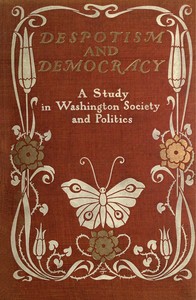
Despotism and Democracy: A Study in Washington Society and Politics — Story, Setting & Ideas
(6 User reviews)
1923
Project Gutenberg
2022
Not confirmed
Political fiction; Washington (D.C.) -- Fiction
Readers of public-domain and historical texts
Project Gutenberg digital edition
en
Edition facts
Words
63,167
Reading time
275 min
Text sections
16
This digital edition of Despotism and Democracy: A Study in Washington Society and Politics — Story, Setting & Ideas is described by source-level measurements including 63,167 words, 4 hr 35 min estimated reading time, and 16 detected text sections.
The text analysis averages about 21.3 words per sentence, while the detected sections provide another way to judge how the source is divided.
Project Gutenberg metadata also associates the work with “Political fiction,” connecting these edition facts with the source record’s subject description.
Source:
Project Gutenberg record #67721
An editorial note examining how Molly Elliot Seawell's 1908 novel uses Washington society and politics as a stage for character-driven drama, focusing on the tension between social ambition and political integrity as revealed in the opening chapters.
Editorial Edition Score
4.8/5
★★★★★
★★★★★
Calculated from edition completeness, EPUB availability, text structure and catalogue metadata. Not a user rating.
How this score is calculated
- Description quality20 pts
- Title & short description10 pts
- Source metadata20 pts
- Text length15 pts
- Chapters / structure15 pts
- EPUB file integrity20 pts
Total of 100 points, scaled to a 2.5-5.0 range. Editions with an empty description or a missing EPUB file are not scored.
Edition quality
Read the Text
to an extraordinary degree. She was no Perdita--no one would have taken her for a princess stolen in infancy. But not Ruth in the harvest-field was more natural, more sweetly graceful than this lady from Circleville, somewhere in the Middle West.
“Annette admired you tremendously,” continued Crane, in the easy tone of a man who knows his wife is desperately in love with him, and thinks her fully justified. “She said it was kind of you to call. Like me, she thought we were going to do wonderful things--I believe she used to pray that our hearts might not be hardened by our social triumphs. Well, you know all about it. We were asked to the President’s receptions, and my wife called on the Cabinet officers’ families, and at the houses of the Senators and the Representatives from our own State. We were asked to dinner at our junior Senator’s house. I thought it would be grand. It was, in a way--the old man is pretty well heeled--but it was exactly like one of those banquets a Chamber of Commerce gives to a distinguished citizen. Annette was the prettiest woman there, but she didn’t wear a low-necked gown like the other women, and that embarrassed her. In the end she found out more things than I did. She said to me before the season was over:
“‘Julian, it’s not being rich that makes people in Washington. If it were, we shouldn’t mind not being in it. But there are plenty of people, like the Senator, who have the money and the wish to make a stir socially--but they can’t, while a plenty of poor ones do. Look at Mr. Thorndyke’--she hit upon you the first man--‘he’s asked everywhere, and he says he is as poor as a church-mouse. No, Julian, to be as you would wish to be here, needs not only the money we haven’t got, but something else we haven’t got and can’t acquire, so let’s give it up. Another winter I’ll stay in Circleville--it will be better for the children, better for me, better for you’--for I own up to having been deuced surly all that winter. So we adopted that plan, and Annette has never been to Washington since. But--I’ll confess this, too--I had from the beginning a fancy to see the inside of those houses where the people live who make up this world of Washington. It wasn’t merely idle curiosity. I was convinced, and I am so still, that the number and variety of people in Washington must make these Washington parlours--drawing-rooms, you call them--the most interesting of their kind in the world. Well--I’ve got into some of them. It’s a good deal easier for a man without his wife than a man with her; and Thorndyke, I own up, I am bewitched. Oh, it’s not so much to you; you’ve known it too long, and seen too much of it all over the world to know how it strikes a man born and brought up until he is thirty-five years old in Circleville. I swear when I get a dinner invitation I am like the girls out our way, who will drive twenty miles in a sleigh to go to a dance. The mere look of the table--the glass, the silver, the flowers--goes to my head. The terrapin intoxicates me. Those quick, soft-moving servants fascinate me. And the conversation! They let me talk all I want.”
“You are a vastly entertaining fellow in your own mental bailiwick,” interjected Thorndyke.
“And the women! So unaffected--so unconscious of their clothes! And such listeners! I have never been to a stupid dinner in Washington. And the club--I never knew a man of leisure in my life until I came to Washington. I daresay you think me a fool.” Crane paused, with a feeling rare to him that he could not express half what was in him, but Thorndyke’s knowledge supplied the rest.
“No, I don’t. It is quite as you say, but you are taking it all too seriously.”
“Circleville,” murmured Crane.
Molly Elliot Seawell opens Despotism and Democracy with a comparison of Washington to Paris on a wet night, immediately establishing a tone of social observation. The first chapter, “Men and Women,” introduces two congressmen—Geoffrey Thorndyke and Julian Crane—whose contrasting backgrounds (Eastern establishment vs. Middle West ambition) set up a central dynamic. The narrative voice is detached and ironic, noting that Crane’s social ambition is “primitive” and that he enjoys society “as the Indian gets out of his pow-wows.” This early detail signals that the novel will scrutinize the rituals of Washington life as much as its political maneuvering.
Social Hierarchies and the Language of Class
The excerpts reveal a keen attention to the gradations of Washington society. Seawell describes how ladies measure status by the era when their families emerged from having “help” to having servants, or changed their dinner hour from two to eight o’clock. This precise social coding is not merely background; it drives the plot. Constance Maitland’s report of the Guild for Superannuated Governesses meeting shows how charitable events become arenas for status competition. Mrs. Hill-Smith, representing families of “1860,” resists newer wealth from “1870.” The novel’s catalog subjects—political fiction and Washington fiction—are thus grounded in a specific social ecosystem where politics and society are inseparable.
Political Ambition as Personal Drama
Seawell intertwines political and personal motives. Thorndyke’s hope that “the majority in the lower House would not… make fools of themselves” is a partisan wish, but it is expressed during a private conversation with Constance, who “womanlike, never could be made to really understand the game of politics.” This gendered observation reflects the novel’s interest in how women navigate political circles. Crane’s social climbing is tied to his political rise; his apartment in a “modish hotel” costs more than he can afford. The excerpts do not reveal the plot’s outcome, but they establish that ambition—both social and political—is a central engine, and that the novel treats it with a mixture of sympathy and satire.
Narrative Voice and Ironic Distance
The narrator frequently steps back to comment on characters’ self-deceptions. Mrs. Baldwin “hugged the delusion that the others did not know about them,” while Constance alone “fathomed the nature of this misunderstood woman.” This ironic omniscience is a consistent feature of the excerpts. The prose is precise and sometimes aphoristic, as when Seawell compares a victoria ride to sitting in a theatre-box. Such comparisons elevate social observation into commentary. The novel’s structure—with chapter titles like “A Rapturous Hour which was Rudely Interrupted” and “There are Men who can Resist Everything except Temptation”—suggests a knowing, almost theatrical framing of events, reinforcing the idea that Washington society is itself a performance.
Readers approaching Despotism and Democracy should attend to the interplay between its political and social registers. The excerpts suggest that Seawell uses the setting of Washington not merely as a backdrop but as a lens through which to examine ambition, class, and gender. The novel’s ironic tone rewards careful reading of its social details—the price of tickets, the timing of dinners, the origins of families. These are not incidental but central to the work’s critique of the democratic ideal in a stratified society.
Reading about Seawell’s Washington, where ambition wears a polished smile, I remembered my grandfather’s stories of polite backrooms. He’d shake his head, saying rules were for show. That same quiet ache surfaced in Shaming the Speed Limit — Context and Discussion, which made me think of speed limits as just another velvet-gloved negotiation between what we claim and what we do. Some books simply hold up a mirror. I put both down, feeling oddly seen.
There are no comments for this eBook.
Reader reflection
How did this book work for you?
Your answers remain private and are stored only in this browser.
Your progress
0
/
10
2
Was reading this book enjoyable?
3
Would you encourage someone else to read it?
4
How easy was the book to follow?
5
Did you relate to its people, ideas, or situations?
6
Is this a title worth rereading?
7
Which element worked best for you?
8
Could you apply anything you learned?
9
In one sentence, what did you learn?
10







Benjamin Campbell
3 weeks ago