About 140 minutes
The Christmas Bishop — A Closer Reading
Fantasy Juvenile Worlds
32,162 recorded words. 19 minutes difference from this book's estimate.
View Gutenberg source #68590
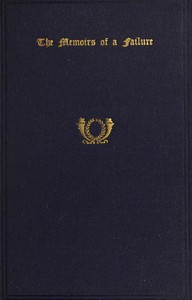
For The Memoirs of a Failure: with an Account of the Man and His Manuscript — Reading Companion, the stored edition analysis reports 36,368 words, 2 hr 39 min estimated reading time, and 4 detected text sections.
The text analysis averages about 17.1 words per sentence, while the detected sections provide another way to judge how the source is divided.
Project Gutenberg metadata also associates the work with “Harvard University -- Fiction,” connecting these edition facts with the source record’s subject description.
Explore this collection
These alternatives are selected using recorded categories and estimated reading time.
About 140 minutes
Fantasy Juvenile Worlds
32,162 recorded words. 19 minutes difference from this book's estimate.
View Gutenberg source #68590About 217 minutes
Fantasy Juvenile Worlds
49,709 recorded words. 58 minutes difference from this book's estimate.
View Gutenberg source #66580About 96 minutes
Fantasy Juvenile Worlds
22,060 recorded words. 63 minutes difference from this book's estimate.
View Gutenberg source #67562Search stored excerpts and compare books → Choose by your preferences →
Choices use stored catalog measurements. Estimates vary with reading speed. A shared category is a catalog label, not a claim that two books have the same argument or literary quality.
Search reads excerpt text stored with this catalog and links to its associated Gutenberg record. The connection is stored in the site database; this tool does not recheck that every excerpt is word-for-word identical to that external record. Excerpt search does not cover every chapter and does not verify historical publication dates.
Catalog snapshot checked: 2026-09-26. Coverage: 95 public books, 95 available source excerpts.
Calculated from edition completeness, EPUB availability, text structure and catalogue metadata. Not a user rating.
Total of 100 points, scaled to a 2.5-5.0 range. Editions with an empty description or a missing EPUB file are not scored.
Public-domain source text
The source text is kept in the dedicated reader, separate from this catalogue record and its commentary.
Kittredge opens with a curious disclaimer: the narrator admits that Dunlevy's character and the meaning of his manuscript will likely remain inscrutable. This framing device immediately establishes a tone of interpretive humility, as the narrator positions himself as a biographer rather than a definitive interpreter. The prose is deliberate, with phrases like "essay at interpretative biography" signaling a self-conscious approach to reconstructing a life from fragments.
The narrator's diction is marked by a formal, almost legalistic precision. He writes of "giving a description" and "relating what little is known," as if compiling evidence. Yet this formality is undercut by admissions of uncertainty: "all that lies within my aim or power is simply to try." The repeated use of "I doubt" and "it is best to admit" creates a voice that is both authoritative and hesitant. This tension between certainty and doubt is a deliberate authorial choice, framing the entire account as an act of salvage rather than revelation.
Kittredge describes Dunlevy from a distance: "we used to watch him from the athletic field." The narrator and his peers are observers, not intimates. Dunlevy is seen standing on stone steps, "looking intently at the lofty porticos," a posture that suggests absorption but also isolation. The description of the Rotunda as "a copy of the Pantheon" introduces a theme of imitation and authenticity. The narrator's gaze is analytical, noting Dunlevy's age and aloofness, but never penetrating his interior. This external perspective is a deliberate limitation, keeping the subject enigmatic.
The embedded manuscript shifts into allegorical dialogue. The "Great Axilla" speaks in a mock-heroic register, addressing the visitor as "puny one" and "little visitor." The diction is ornate: "His Excelsior," "Fountain of Endurance," "acrid grapes of Ennui." The dialogue serves as a vehicle for social commentary, contrasting the "misfits and unfits" with the wealthy on the boulevard. The Axilla's speech is didactic, yet the visitor's responses—"I pondered once more, but said nothing"—maintain a tone of bemused observation. The allegory is explicit, but the author's choice to embed it within a manuscript adds layers of mediation.
Within the allegory, the Axilla points out a dilettante who "imagines that he is different from the horde, because he sits by and watches them." This figure mirrors the narrator's own position as an observer of Dunlevy. The Axilla's critique—that the dilettante is "tired of it all, for he, too, has nothing to do"—suggests a self-reflexive commentary on the act of observation itself. Kittredge's choice to include this meta-commentary within the manuscript creates a recursive structure: the narrator observes Dunlevy, who may have observed others, and the manuscript observes observers. The diction here is sharp, with the Axilla's "mark me" and "follow his gaze" directing the reader's attention to the act of looking.
The allegory's spatial details are precise: the fountain, the boulevard, the bench hidden by privet bushes. The Axilla explains that the bench "looks more comfortable than the others, but in reality it is hard and poses them in unnatural postures." This description of the women—"they paint and powder, and their cologne fairly makes me ill"—is blunt and judgmental. The authorial choice to include such a scene, with its explicit moralizing, contrasts with the narrator's earlier restraint. The dialogue's tone shifts from philosophical to sardonic, revealing a range of registers within the manuscript. The visitor's sad acknowledgment—"I did not think that you had them in here, too"—adds a note of disillusionment.
Kittredge's work resists easy categorization: part biography, part allegorical fiction, it is held together by a narrator who is acutely aware of the limits of his knowledge. Readers should attend to the shifts in voice between the framing narrative and the embedded manuscript, as these tonal contrasts reveal the author's deliberate construction of an enigmatic subject. The editorial note invites a reading that values ambiguity over resolution.
There is a particular tenderness in watching a man patch his own story, as Kittredge does with Dunlevy’s manuscript—each careful correction a small mercy. I recall, too, the quiet stubbornness of Metzerott’s shoemaker, hammering faith into leather. Both books hold that ache of repair. Metzerott, Shoemaker — A Reader’s Guide sits beside the memoirs on my shelf like an old friend who understands the same long silences.
A brief reflection can help important ideas stay with you longer.