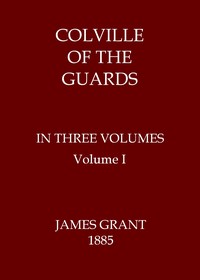
Colville of the Guards, Volume 1 (of 3) — A Reader’s Guide
Edition facts
Before opening Colville of the Guards, Volume 1 (of 3) — A Reader’s Guide, the edition data offers a quick orientation: 49,709 words, 3 hr 37 min estimated reading time, and 5 detected text sections.
The text analysis averages about 24.6 words per sentence, while the detected sections provide another way to judge how the source is divided.
Project Gutenberg metadata also associates the work with “Soldiers -- Fiction,” connecting these edition facts with the source record’s subject description.
Calculated from edition completeness, EPUB availability, text structure and catalogue metadata. Not a user rating.
How this score is calculated
- Description quality20 pts
- Title & short description10 pts
- Source metadata20 pts
- Text length15 pts
- Chapters / structure15 pts
- EPUB file integrity20 pts
Total of 100 points, scaled to a 2.5-5.0 range. Editions with an empty description or a missing EPUB file are not scored.
Read the Text
'You are a dear and good-hearted jewel, Mary!' said Ellinor. 'How you can constantly face and soothe the sorrows and miseries of all these poor people, I cannot conceive; I am not selfish, I hope, and yet the frequent task would he too much for me.'
'You are not without a tender heart,' replied Mary, as she set down her little hand-basket, now empty. 'I have paid but one visit to-day--a very sorrowful one--and I am glad to be back again in our own pretty home. When I saw old Elspat the funeral was over, and dear Dr. Wodrow had brought her back to the little lonely cottage from which her husband had been borne away. It was so sad and strange to see the empty bed, with a plate of salt upon the pillow, and the outline of his coffin still on the coverlet, and the now useless drugs and phials on a little table, close by--sad reminiscences that only served to torture poor Elspat, whose grey head the minister patted kindly, while telling her, in the usual stereotyped way, that whom He loved He chastened--that man is cut down like a reed--all flesh is grass, and so forth. But old Elspat shall not live alone now--she is to come here, and be a kind of factotum for us.'
'That is like your kind, considerate heart, Mary; always thinking of others and never of yourself.'
'When I think of the brightness of our own home, Ellinor--though death has twice darkened it--and compare it with that of old Elspat, my heart throbs with alternate gratitude and sorrow.'
'Poor Elspat Gordon.'
The speakers were sisters, two bright and handsome girls, one of whom had just returned from an errand of charity and benevolence, while the younger was seated in a garden before her easel and paint-block, on which she was depicting, for perhaps the twentieth time, the features of their home, Birkwoodbrae--works of art in which their favourite fox-terrier Jack always bore a prominent part; and Jack, his collar duly garlanded with fresh rosebuds and daisies, was now crouched at the feet of the fair artist.
Mary Wellwood was fair-haired, with darkly-lashed eyes of violet-blue. Many would call her very handsome, but few merely pretty. She was far beyond the latter phrase. With all its soft beauty and dimples, there were too much decision and character in her face to justify the simple term prettiness, while it was a face to haunt one a life long!
Two years younger than Mary, Ellinor was now twenty. Her dark hazel eyes were winning in expression, and, like Mary's, longly-lashed, and what lovely lips she had for kisses! Hers was no button of a mouth, however. Critics might say that it was a trifle too large; but her lips were beautifully curved, red, and alluring, often smiling, and showing the pure, pearl-like teeth within; and yet, when not smiling, the normal expression of Ellinor's face was thoughtful.
The orphan daughters of Colonel Wellwood--a Crimean veteran--the two girls lived alone in their pretty sequestered home at Birkwoodbrae. They had not a female relation in the world whom they could have invited to share it; and though sometimes propriety suggested a matron or chaperone as a necessity to two handsome and ladylike girls, living almost under the shadow of the manse, and as the minister, Dr. Wodrow, had been left by their father on his death-bed a species of guardian to them, 'why hamper themselves with some uncomfortable old frump, when they could be perfectly happy without her, with their father's old servants about them?' was always the after reflection of each.
Thus for three years the time had glided away, and Mary's life we shall show to have been a busy, active, and useful one, adding to and nearly doubling indeed the little income left them by their father, through her own efforts in the production and sale of the agricultural produce of the few acres of Birkwoodbrae, with a skill and independence of spirit that won the admiration and respect of all who knew her.
Yet the house they loved so well, and the patch of land around it, did not belong to the orphan sisters.
The heir of the entail--for, according to 'Shaw's Index,' small though the property of Birkwoodbrae might be, it had been entailed as far back as 1696, with date of tailzie 1694, by Ronald Wellwood, a remote ancestor, who was one of the many victims of King William's treachery at Darien--the heir of entail, we say, held a lucrative diplomatic appointment abroad, and left his two nieces in undisturbed enjoyment of the house and lands.
The novel opens with a contrast between two sisters: Mary, returning from a charity visit to a widow, and Ellinor, painting their home with their fox-terrier Jack. Mary's description of the empty bed, the plate of salt on the pillow, and the outline of the coffin on the coverlet establishes a vivid, domestic grief. This attention to material detail—the useless drugs, the minister's stereotyped consolations—marks Grant's style: he grounds emotional turmoil in concrete, almost tactile objects.
Soon after, at a garden-party, Mary meets Captain Leslie Colville, a Guardsman. Their exchange is charged with ambiguity: Colville carves their initials into a tree, recites a song linking her name to his, and places her bouquet in his breast-pocket. Yet Mary suspects he is already attached to Blanche Galloway. The narrative voice repeatedly notes her "mixed emotions" and "curious sense of wrong," hinting at a romance built on misunderstanding and social peril.
The Weight of Objects and Gestures
Grant invests everyday items with emotional weight. The empty bed with its plate of salt, the outline of the coffin on the coverlet, the bouquet of berries kissed and pocketed—these objects become carriers of memory and intent. When Colville carves initials and a true lovers' knot into a tree, Mary is "appalled" not by the act but by its visibility. The narrative lingers on the physical traces of feeling: the perfume of roses, the drowsy hum of the band, the touch of a hand that seems to magnetise. This attention to sensory detail creates a world where inner states are externalised through things and settings.
Voices in Counterpoint
The dialogue reveals a persistent gap between what is said and what is understood. Mary and Colville are "at cross-purposes"—she fears Blanche will see the carving; he worries young Wodrow might. When Colville quotes "The Birks of Invermay," Mary hears a declaration; he may only be flirting. The narrative voice frequently glosses their thoughts: "his tenderness seemed very true, but might be—nay, Mary thought, must be—mere flirtation." This technique of alternating perspectives keeps the reader attuned to the characters' self-deceptions and the social codes that govern their speech.
The Shadow of the Coming War
Though the excerpts focus on domestic and romantic tensions, the catalog subjects—"Soldiers -- Fiction; British -- Afghanistan -- Fiction"—and the title's reference to "the Guards" signal that military duty will intrude. The garden-party idyll is already haunted by Colville's impending return to "the great whirling world of 'Society'" and, presumably, to active service. Mary's poverty and Colville's rank create a class barrier that the romance must cross. The novel's structure, as a three-volume work, suggests that this first volume establishes the emotional stakes before the war disrupts them.
Readers should attend to how Grant uses physical details—a carved tree, a pocketed bouquet—to externalise inner conflict. The narrative's habit of reporting characters' unspoken thoughts creates a layered irony: we see more than either Mary or Colville admits. This first volume sets up a romance that is as much about social surveillance and class anxiety as it is about love. The coming volumes will likely test these bonds against the realities of colonial warfare.
Reading about Mary’s hesitant visits to Captain Colville, I found myself thinking of quieter captivity—how we’re bound by class and war as surely as by walls. It reminded me of The Prince of the Captivity: The Epilogue to a Romance — Background and Themes, where that same sense of waiting lingers, like an old photograph left in the sun.
Elijah Williams
1 month agoWyatt Flores
1 month ago-
Ryan Tanner - 1 month ago
The first volume is a slog. It takes ages to introduce the main plot, and the characters are cardboard cutouts. The military setting feels under-researched, with anachronistic details. The dialogue is stiff, and there's little to hook the reader. Not recommended unless you're desperate for a historical novel. -
Ashley Stephenson - 2 weeks ago
A solid beginning that lays a strong foundation, but the action is sparse in the first half, focusing more on character development. The prose is engaging, but some redundancies could have been trimmed. Still, intriguing enough to continue the series. -
Jason Skinner - 2 weeks ago
An excellent start to the Colville series. Volume 1 sets the stage beautifully, introducing a protagonist caught between duty and morality. The author paints a vivid picture of the military life, and the political intrigue is spellbinding. The pacing is just right, making it hard to put down. I'm eagerly awaiting the next installment.
Take a moment to reflect on this book
Create a short personal record of your experience with this book.
Mia Wilson
1 month ago