About 605 minutes
Peace with Honour — Reading Notes
Fantasy Juvenile Worlds
139,125 recorded words. 5 minutes difference from this book's estimate.
View Gutenberg source #66076
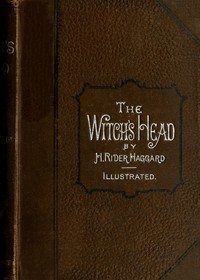
For The Witch's Head — Text and Context, the stored edition analysis reports 140,095 words, 10 hr 10 min estimated reading time, and 48 detected text sections.
The text analysis averages about 17.3 words per sentence, while the detected sections provide another way to judge how the source is divided.
Project Gutenberg metadata also associates the work with “South Africa -- Fiction,” connecting these edition facts with the source record’s subject description.
Explore this collection
These alternatives are selected using recorded categories and estimated reading time.
About 605 minutes
Fantasy Juvenile Worlds
139,125 recorded words. 5 minutes difference from this book's estimate.
View Gutenberg source #66076About 591 minutes
Fantasy Juvenile Worlds
135,805 recorded words. 19 minutes difference from this book's estimate.
View Gutenberg source #66558About 497 minutes
Fantasy Juvenile Worlds
114,093 recorded words. 113 minutes difference from this book's estimate.
View Gutenberg source #67671Search stored excerpts and compare books → Choose by your preferences →
Choices use stored catalog measurements. Estimates vary with reading speed. A shared category is a catalog label, not a claim that two books have the same argument or literary quality.
Search reads excerpt text stored with this catalog and links to its associated Gutenberg record. The connection is stored in the site database; this tool does not recheck that every excerpt is word-for-word identical to that external record. Excerpt search does not cover every chapter and does not verify historical publication dates.
Catalog snapshot checked: 2026-09-26. Coverage: 95 public books, 95 available source excerpts.
Calculated from edition completeness, EPUB availability, text structure and catalogue metadata. Not a user rating.
Total of 100 points, scaled to a 2.5-5.0 range. Editions with an empty description or a missing EPUB file are not scored.
Public-domain source text
The source text is kept in the dedicated reader, separate from this catalogue record and its commentary.
From its opening line—'Come here, boy, let me look at you'—H. Rider Haggard establishes a world where characters are scrutinized and judged. The novel’s diction oscillates between the elevated, almost biblical language of Ernest’s love letters and the blunt, sardonic remarks of Mr. Alston. This contrast is not merely stylistic; it reflects a central tension between romantic idealism and hard-won cynicism. Haggard’s dialogue often serves as a vehicle for character revelation, with Alston’s aphorisms—'women are fond of playing dirty tricks'—undercutting Ernest’s fervent declarations. The prose itself mirrors the dual settings: the measured cadences of English country life give way to the sharper, more immediate rhythms of the South African frontier.
Haggard differentiates his characters through their word choices. Ernest’s speech is florid and abstract: he speaks of 'ideals of ivory and gold' and writes letters that Mr. Alston dismisses as 'exalted composition.' Alston, by contrast, favors concrete, earthy language—'go in for an Intombi'—and his metaphors draw on physical experience ('throw your pearls before swine'). Jeremy, the third figure in the trio, is given simpler, more direct lines: he 'scratched his head' and calls Ernest’s letter 'deep enough to fetch any girl.' The narrator’s own diction shifts accordingly: when describing Ernest’s emotions, the prose becomes ornate; when reporting Alston’s opinions, it turns terse and ironic. This technique allows Haggard to dramatize conflicting worldviews without explicit commentary.
The excerpted scene between Ernest, Alston, and Jeremy is built around a series of verbal clashes. Alston’s interruptions—'All right, my lad—all right'—and his habit of reinterpreting Ernest’s idealism as naivety create a rhythm of assertion and deflation. Haggard uses dialogue tags sparingly, letting the characters’ tones emerge from their phrasing. When Ernest 'fired up' and 'stamped out of the room,' the physical action underscores the emotional stakes. Notably, Alston’s cynicism is not presented as pure wisdom; his claim that 'women are fond of playing dirty tricks' is undercut by the narrative’s own sympathy for Ernest’s earnestness. The dialogue thus enacts a genuine debate about love, trust, and experience, with neither voice fully endorsed.
Haggard’s descriptive passages often focus on the body in motion or under strain. The fight with the giant is rendered through specific, kinetic details: Jeremy’s 'lift' causes an 'injury to the spine,' and the aftermath is described in terms of physical distress—'This intelligence distressed Jeremy not a little.' The narrator lingers on the giant’s condition ('not, however, in much pain') with a clinical detachment that contrasts with Jeremy’s emotional response. Elsewhere, Ernest’s 'sulky' posture on the waggon box and his 'stamping out' of the room are small but telling gestures. Haggard uses such physical markers to externalize inner states, a technique that aligns with his broader interest in visible action as a window into character.
The novel’s three-book structure—moving from England to South Africa and back—is anticipated in the early chapters by the way Haggard contrasts domestic and frontier spaces. The opening scene takes place in an undefined interior ('Come here, boy'), but the narrative quickly shifts to outdoor, liminal locations: the waggon, the by-street, the outspan. Alston’s advice to 'go in for an Intombi' introduces the colonial setting’s raw realities, while Ernest’s letter, with its talk of 'mountains' and 'depths,' tries to impose a romantic framework on that same landscape. Haggard does not resolve this tension; instead, he lets the settings speak for themselves. The English chapters are more dialogue-heavy and static; the African sections, as glimpsed in the excerpts, are more action-driven and spatially expansive.
Readers attentive to Haggard’s craft will notice how he uses verbal and physical detail to build character without explicit moralizing. The novel rewards attention to its shifts in register—from the lofty to the colloquial—and to the way its settings shape the possibilities of action. The excerpts suggest a work less concerned with plot mechanics than with the friction between how people speak and what they do.
Reading about Ernest’s romantic ideals clashing with Mr. Alston’s weary realism brought back a summer I spent under a heavy oak, lost in old letters my grandfather wrote from the front. He never spoke of it, but the silence between his lines said everything. That same quiet ache surfaced in Our Village in War-time — Key Ideas to Explore, where the pastoral peace feels haunted. Some books hold a place for what’s unsaid.
Your answers remain private and are stored only in this browser.