1

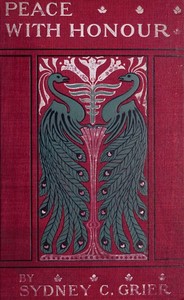
Peace with Honour — Reading Notes
(12 User reviews)
3702
Project Gutenberg
2021
Not confirmed
Women physicians -- Fiction; British -- Asia -- Fiction
Readers of public-domain and historical texts
Project Gutenberg digital edition
en
Edition facts
Words
139,125
Reading time
605 min
Text sections
12
This digital edition of Peace with Honour — Reading Notes is described by source-level measurements including 139,125 words, 10 hr 5 min estimated reading time, and 12 detected text sections.
The text analysis averages about 20.7 words per sentence, while the detected sections provide another way to judge how the source is divided.
Project Gutenberg metadata also associates the work with “Women physicians -- Fiction,” connecting these edition facts with the source record’s subject description.
Source:
Project Gutenberg record #66076
A British diplomat and a soldier navigate personal rivalries and political intrigue on the Khemistan Frontier, where a treaty signing is complicated by a woman physician and the threat of war.
Editorial Edition Score
4.9/5
★★★★★
★★★★★
Calculated from edition completeness, EPUB availability, text structure and catalogue metadata. Not a user rating.
How this score is calculated
- Description quality20 pts
- Title & short description10 pts
- Source metadata20 pts
- Text length15 pts
- Chapters / structure15 pts
- EPUB file integrity20 pts
Total of 100 points, scaled to a 2.5-5.0 range. Editions with an empty description or a missing EPUB file are not scored.
Edition quality
Read the Text
rom the brim of which the rain-drops were falling on her wind-blown hair, for the umbrella she held in her hand--a mere mass of metal spikes and shreds of silk--could only be called an umbrella by courtesy, and had evidently given way before the force of the gale.
“Any port in a storm!” she said, merrily, as she shook hands with Dick.
“I am sorry I can’t offer to lend you an umbrella,” he remarked, “for I am worse off than yourself.”
“No, I think you are more sensible,” she replied, “for an umbrella is sure to be turned inside out in this wind. You see I am prepared for rain, and I have no fear of getting wet, but I do dislike it when the rain-drops trickle down my neck.”
“Pray allow me to run across and get you an umbrella from one of those shops over there,” he said stiffly, annoyed to find his resentment against her melting under the influence of her friendly manner.
“Oh no, thank you, I couldn’t think of it,” she replied, surveying him carefully, and taking due note of his curly-brimmed hat, his long coat, the huge carnation in his buttonhole, and the immaculate spats protecting his equally spotless boots. “You are not quite dressed for running anywhere, are you?”
The resentment returned promptly in full force.
“I am sorry my appearance is displeasing to you,” he said, in a tone which he tried vainly to make a light and sportive one.
“Oh, but it isn’t at all. It is most correct--unimpeachably correct.”
“Then what is the matter with it, if I may ask?”
“I don’t want to hurt your feelings.”
“Thank you, I think my feelings are proof against injury.”
“It is only that I was thinking it was a pity to expose such a complete get-up to the dangers of a muddy walk. A hansom would have taken you straight from General North’s door to your destination. I could imagine you a walking advertisement of the Army and Navy Club, and why aren’t you gracing one of the windows there, as a sort of sample, you know, to show the kind of goods within?”
“Bother the girl! She sees I don’t like her, and she is taking it out of me,” was his mental comment, as he glanced at her composed face and caught a twinkle of fun in her eyes. Aloud he said, rather lamely, “You don’t know what a luxury it is to be able to array oneself in the garments of civilisation once more, after spending years, as one might say, in uniform. But I see the rain has stopped. May I call you a cab, or walk with you?”
“Oh no, thanks; I am only going to one of those shops.”
“But you will allow me to see you across the street?”
This time his escort was not refused, and he left her at the entrance of the shop to which she was bound, and in which, as he noticed with a shudder, the wares displayed were chiefly surgical instruments. As he lifted his hat and turned away, he found his state of mind not at all in accordance with the serene calm of his destination. Everything Miss Keeling had said seemed to be rankling in his breast, and he anathematised her mentally as he walked. What business had the girl to say such things? Nay, rather, what did it signify if she did say them? Why in the world should it affect him? And yet, here he was wasting his time and spoiling his short leave at home by thinking about her. It was bad enough that they were doomed to be fellow-travellers all the way to Kubbet-ul-Haj, but at least he would dismiss her from his mind while he was in England; and by way of making a beginning he would burn that photograph which he had cherished so long.
The novel opens with a sharp exchange between Mabel North and her brother Dick, a soldier recently returned from seven years on the Khemistan Frontier. Mabel insists he accompany her to see 'the serious side of my life,' hinting at a role beyond social butterfly. The dialogue establishes a teasing yet affectionate sibling dynamic, with Dick's reluctance countered by Mabel's determination. The setting—a conservatory where she snatches his cigar and newspaper—immediately signals a domestic space where power plays unfold. This personal scene contrasts with the later political tensions, as the narrative quickly shifts to frontier diplomacy and the high stakes of a treaty signing.
Diplomatic Maneuvers and Personal Stakes
The excerpts reveal a central conflict around a treaty that Stratford, a diplomat, is desperate to sign. He appeals to Dick North to waive his claim to sacrifice himself for Miss Keeling, framing it as 'a matter of personal moment.' Stratford's language is precise and strategic: he admits Dick could 'die like a hero' but insists tact is needed in statecraft. The treaty's importance is underscored by Stratford's elaborate plan to verify his signature—if forced to sign under duress, the words will 'run into one another.' This detail, along with his instructions for escape and his mention of a sister not seen in twenty years, humanizes a character otherwise consumed by political necessity.
Women Physicians and Colonial Context
The catalog subjects list 'Women physicians -- Fiction' and 'British -- Asia -- Fiction,' yet the excerpts offer limited direct evidence of a woman doctor. Mabel North's insistence on showing her brother 'the serious side of my life' might imply professional involvement, but the text does not confirm her as a physician. Instead, the narrative focuses on Miss Keeling as a figure of romantic interest and potential sacrifice. The colonial setting is more explicit: references to the Khemistan Frontier, Fort Rahmat-Ullah, and 'Indian fighting on the Plains' place the story within British imperial expansion. The Armenian translator Kustendjian, whose 'English seemed almost to have forsaken him under the influence of horror,' hints at the multicultural tensions of the region.
Voice and Structure: Dialogue-Driven Tension
The excerpts are dominated by rapid, witty dialogue that conveys character and conflict without lengthy exposition. Mabel's teasing, Dick's sardonic replies, and Stratford's measured urgency all emerge through speech. The narrative is structured around conversations—in the conservatory, on the terrace, in the office—that advance the plot while revealing relationships. The use of chapter titles like 'Should Auld Acquaintance Be Forgot?' and 'A Community of Interests' suggests a thematic interest in bonds tested by circumstance. The epilogue title 'Peace with Honour' echoes the book's title, framing the resolution as a negotiated outcome rather than a triumphant victory.
Readers should attend to how the novel balances personal relationships against political imperatives. The excerpts show characters negotiating loyalty, sacrifice, and duty through dialogue rather than action. The incomplete excerpts leave the role of the women physician unclear, but the emphasis on treaty negotiations and frontier danger suggests a plot driven by brinkmanship. Pay attention to how Grier uses setting—from domestic interiors to remote outposts—to mirror the characters' internal conflicts.
Rereading my notes on Peace with Honour, I was struck by how often the diplomat’s nerves frayed over small, crucial gestures—a handshake, a folded map. It reminded me, oddly, of the breathless tension in Toying with fate; or, Nick Carter's narrow shave — Reading Companion, where a single misstep likewise feels like the turning point of a world. Both left me with that quiet, churning sense of fate’s hinges.
Anthony Moore
3 weeks ago-

Christopher Miller - 1 month ago
A profound and moving exploration of what it truly means to find peace after conflict. The narrative is beautifully crafted, with rich character development that draws you into the emotional journey. Reading 'Peace With Honour' was a transformative experience that left me reflecting on my own beliefs long after the final page. Highly recommended for anyone seeking a meaningful and uplifting read. -
Taylor Mitchell - 4 weeks ago
While the premise is intriguing, 'Peace With Honour' fails to deliver a compelling narrative. The characters feel flat and uninspired, and the plot meanders without a clear direction. The philosophical musings, though noble, come across as pretentious rather than profound. I struggled to finish this book and was ultimately disappointed by the lack of emotional resonance. -
Elizabeth Jordan - 3 weeks ago
The book offers a thoughtful commentary on the complexities of peace and honor, with moments of genuine insight. The prose is elegant, and the themes are timely. However, at times the pacing feels uneven, and some subplots could have been developed further. Still, it's a worthwhile read for those interested in philosophical narratives.
Reader reflection
Your personal reading reflection
Build a private reading journal entry for this title.
Your progress
0
/
10
2
What was your overall reaction to the book?
3
Would you encourage someone else to read it?
4
How demanding did the text feel?
5
How much did the book move you?
6
Could you apply anything you learned?
7
Was the book moving at the right speed?
8
Which aspect of the book did you value most?
9
What did this book teach you most?
10


Grayson Garcia
4 weeks ago