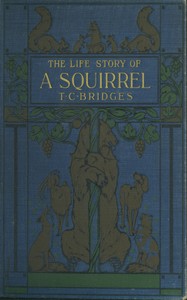
The narrator, a red squirrel named Scud, begins his story on a June morning, shivering on a larch bough, afraid to jump. The opening paragraph establishes a precise sensory world—'the hot resinous scent of pine-needles'—and a voice that is both animal and articulate. Scud admits he is not giddy, 'a squirrel never is,' but the distance to his mother below feels immense. This first adventure, a leap of faith, sets the pattern for a life story built around physical challenges and narrow escapes. The book belongs to a series called 'Animal Autobiographies,' and Bridges uses the first-person form to blend natural history observation with a fictional squirrel's perspective, complete with named companions like Rusty and Hazel.
A Squirrel's Voice and World
Scud's narration is the book's central device. He describes his world through squirrel senses—scent, sound, and the constant awareness of height and distance. The prose is direct and unadorned, with occasional colloquial touches: 'What's up?' inquired I. The animal characters speak in a plain, conversational English, without sentimentality. The natural setting is rendered with specificity: larch, beech, Spanish chestnut, pollard oak. Bridges includes details of squirrel behavior—rummaging for mast, hiding in knot-holes, the fear of falling—that ground the fantasy in observable fact. The result is a voice that feels both invented and informed, a creature who can describe a wild-cat's 'grey coat, stiff and coarse' and also joke about pheasants making 'jeering remarks.'
Encounters with Danger
The excerpts show a pattern of threat and escape. Early chapters introduce a weasel, then a fox, but the most striking predator is the wild-cat, described by a traumatized stranger: 'a great cat had sprung out of a patch of dead bracken' and killed his brother with 'two quick swings of her terrible paws.' The description is precise and visceral—the cat's 'velvet-cushioned paws,' her 'short tail, broad head, and small, close-rounded ears.' Later, human hunters appear: 'the little stout man with the mutton-chop whiskers, his white-collared, pasty-faced son, and a tall keeper with a ginger beard.' These are not generic villains but specific, almost caricatured figures. The squirrels learn to assess risk, distinguishing between incompetent shooters and real threats like the new keeper.
The Social Life of the Coppice
Scud's world is populated by named squirrels—his mother, his brother Rusty, his eventual wife Hazel—and a network of other animals. The stranger with the wild-cat wound is given a voice and a story; he is not merely a plot device. The squirrels share information, warn each other, and offer food: 'Come with us up into our beech-tree, and I'll find you a better breakfast.' There is a sense of community and territory, with a 'coppice' as home ground. The book also includes other species: pheasants who 'made jeering remarks,' a dog that 'bounded high' in the final illustration. The social structure is hierarchical and cautious, with older squirrels passing down knowledge—'Mother says that a very old squirrel once told her that his father had seen a wild-cat.'
Structure and the Reader's Path
The table of contents reveals a clear arc: from 'My First Adventure' through 'The Great Disaster,' 'The Pleasures of Imprisonment,' 'A Day in Rat Land,' and back to the woodlands, then a series of escalating threats—'The Grey Terror,' 'War Declared Against Our Race,' 'Poachers and a Battue'—ending with 'My Last Adventure.' The chapter titles promise both episodic adventure and a cumulative life story. The illustrations by Allan Stewart, listed with captions, offer visual anchors: 'Father leaped straight towards the boy, landing actually on his shoulder,' 'Two cruel green orbs set in a wide grey face.' A first-time reader can follow Scud's growth from a fearful youngster to an experienced adult, facing predators both natural and human, in a narrative that balances observation with drama.
Bridges wrote within a specific Edwardian tradition of animal autobiography, aiming to instruct as well as entertain. The book rewards a reader who pays attention to the natural details—the scent of pine, the texture of bark, the habits of prey and predator—while also enjoying the invented drama of Scud's voice. The excerpts suggest a work that is more interested in the squirrel's perspective than in plot mechanics, so a patient reading that savors the descriptive passages will yield more than one that rushes toward action. The final chapter's title hints at an ending, but the excerpts do not reveal it.