1

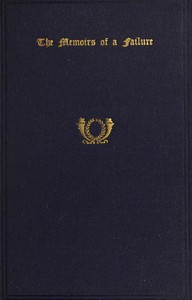
The Memoirs of a Failure: with an Account of the Man and His Manuscript — Reading Companion
(8 User reviews)
1488
Project Gutenberg
2022
Not confirmed
Harvard University -- Fiction; Failure (Psychology) -- Fiction; University of Virginia -- Fiction
Readers of public-domain and historical texts
Project Gutenberg digital edition
en
Edition facts
Words
36,368
Reading time
159 min
Text sections
4
For The Memoirs of a Failure: with an Account of the Man and His Manuscript — Reading Companion, the stored edition analysis reports 36,368 words, 2 hr 39 min estimated reading time, and 4 detected text sections.
The text analysis averages about 17.1 words per sentence, while the detected sections provide another way to judge how the source is divided.
Project Gutenberg metadata also associates the work with “Harvard University -- Fiction,” connecting these edition facts with the source record’s subject description.
Source:
Project Gutenberg record #67204
An editorial note on Daniel Wright Kittredge's 1908 work, focusing on the authorial choices in diction, dialogue, and description as seen in the framing narrative and the embedded manuscript of William Wirt Dunlevy.
Editorial Edition Score
4.6/5
★★★★★
★★★★★
Calculated from edition completeness, EPUB availability, text structure and catalogue metadata. Not a user rating.
How this score is calculated
- Description quality20 pts
- Title & short description10 pts
- Source metadata20 pts
- Text length15 pts
- Chapters / structure15 pts
- EPUB file integrity20 pts
Total of 100 points, scaled to a 2.5-5.0 range. Editions with an empty description or a missing EPUB file are not scored.
Edition quality
Read the Text
evy was a student at the University of Virginia at the time when some of us, who were undergraduates, began to notice and comment upon his personality. He was considerably older than the other students; and we imagined that this was the reason why he held himself aloof from us. We used to watch him from the athletic field on pleasant afternoons. He was wont to stand on the great flight of stone steps which led from a shaded avenue to gently sloping terraces that lie before the Rotunda, the name of the college library. Dunlevy used to stand at the foot of these steps, looking intently at the lofty porticos, as though impressed with the majesty of this copy of the Pantheon, its majesty in all its simplicity.
The terraces are connected on the sides by open colonnades, forming two interior courts. In them, for indefinite periods, Dunlevy was accustomed to walk, his hands crossed behind him, gazing out upon the distant wooded valleys of the Blue Ridge Mountains. We wondered what sort of man he might be, who was as sufficient unto himself as the fixed stars in the sky which radiate no other light than their own.
He came to take his meals in the same dining-hall with us; indeed I sat at the table beside him. I think he liked me, because I let him alone. I did not attempt conversation. It was noticeable that he tried to come to his meals after the others had finished eating. But he found this difficult, as one burly foot-ball player usually remained as long as anything remained on the table. This fellow used to make stupid, broadside sallies at Dunlevy, who had the look of a man who had once been strong and robust, but who was now almost ashamed of his grotesque appearance. Dunlevy did not try to stop the foot-ball player in any of his onslaughts of muscular wit. The latter’s name was Crowther. I used to think that Crowther’s conception of wit amused Dunlevy more often than it irritated him.
One morning at breakfast I made a most inane remark for a place where all the conversation was devoted to the subject of athletics, such as who was the Harvard full-back in ’94 or what was the best batting average last year. My remark was totally out of place, as it had to do with literature. It happened this way: when I came into the dining-hall I noticed a copy of one of Cardinal Newman’s works sticking out of the pocket of Dunlevy’s overcoat. And as I took my seat at the table no one was saying anything, so I merely remarked how much I admired Newman’s style. Every one stared at me except Dunlevy, who was smiling at my thoughtlessness.
“What is it in the cardinal’s fashion that you admire so much?” asked Crowther.
“The color of his coat, of course;” suggested Dunlevy with a straight face.
“Why, what color was it?” asked Crowther, seriously knitting his brow.
“He preferred red,” answered Dunlevy, “because his books were not read.”
The bell rang for nine o’clock lectures; and Dunlevy and I were left alone.
That was the last time we had breakfast together at the University of Virginia. Dunlevy had overtaxed himself by his work in the School of Philosophy, and broke down in health.
All of us knew where he lived, even if none of us had seen the inside of his quarters. He rented the ground floor of an old private residence which was situated just beyond the University limits. It was set upon a knoll, and from this point one could obtain a clear view of Monticello, the home of Jefferson. I presumed so much upon my slight acquaintance with Dunlevy as to deem it a simple duty to go to see him. I was ushered into his chamber by an old negro servant who had not succeeded in intercepting me. I found Dunlevy propped up in bed, reading a book. He laid it across his chest open, and looked at me as though he could not believe my presence.
“Why, you have come to see me, haven’t you?” he said. The poor man seemed to beam at the thought that some one had actually come to call upon him.
“I heard that you were sick.”
“And did you let the gentleman in, Sandy?” he asked of the negro, at the same time trying to conceal a frown from me.
“Maarstar, don’t you say I done it. He say he be a doctor and was sent for!”
“My trick succeeded even if it was impudent;” I said.
Dunlevy was confused.
Kittredge opens with a curious disclaimer: the narrator admits that Dunlevy's character and the meaning of his manuscript will likely remain inscrutable. This framing device immediately establishes a tone of interpretive humility, as the narrator positions himself as a biographer rather than a definitive interpreter. The prose is deliberate, with phrases like "essay at interpretative biography" signaling a self-conscious approach to reconstructing a life from fragments.
The Narrator's Self-Conscious Voice
The narrator's diction is marked by a formal, almost legalistic precision. He writes of "giving a description" and "relating what little is known," as if compiling evidence. Yet this formality is undercut by admissions of uncertainty: "all that lies within my aim or power is simply to try." The repeated use of "I doubt" and "it is best to admit" creates a voice that is both authoritative and hesitant. This tension between certainty and doubt is a deliberate authorial choice, framing the entire account as an act of salvage rather than revelation.
Observing Dunlevy Through Distance
Kittredge describes Dunlevy from a distance: "we used to watch him from the athletic field." The narrator and his peers are observers, not intimates. Dunlevy is seen standing on stone steps, "looking intently at the lofty porticos," a posture that suggests absorption but also isolation. The description of the Rotunda as "a copy of the Pantheon" introduces a theme of imitation and authenticity. The narrator's gaze is analytical, noting Dunlevy's age and aloofness, but never penetrating his interior. This external perspective is a deliberate limitation, keeping the subject enigmatic.
The Allegorical Dialogue of the Axilla
The embedded manuscript shifts into allegorical dialogue. The "Great Axilla" speaks in a mock-heroic register, addressing the visitor as "puny one" and "little visitor." The diction is ornate: "His Excelsior," "Fountain of Endurance," "acrid grapes of Ennui." The dialogue serves as a vehicle for social commentary, contrasting the "misfits and unfits" with the wealthy on the boulevard. The Axilla's speech is didactic, yet the visitor's responses—"I pondered once more, but said nothing"—maintain a tone of bemused observation. The allegory is explicit, but the author's choice to embed it within a manuscript adds layers of mediation.
The Dilettante as a Mirror
Within the allegory, the Axilla points out a dilettante who "imagines that he is different from the horde, because he sits by and watches them." This figure mirrors the narrator's own position as an observer of Dunlevy. The Axilla's critique—that the dilettante is "tired of it all, for he, too, has nothing to do"—suggests a self-reflexive commentary on the act of observation itself. Kittredge's choice to include this meta-commentary within the manuscript creates a recursive structure: the narrator observes Dunlevy, who may have observed others, and the manuscript observes observers. The diction here is sharp, with the Axilla's "mark me" and "follow his gaze" directing the reader's attention to the act of looking.
The Fountain of Endurance and the Bench of Women
The allegory's spatial details are precise: the fountain, the boulevard, the bench hidden by privet bushes. The Axilla explains that the bench "looks more comfortable than the others, but in reality it is hard and poses them in unnatural postures." This description of the women—"they paint and powder, and their cologne fairly makes me ill"—is blunt and judgmental. The authorial choice to include such a scene, with its explicit moralizing, contrasts with the narrator's earlier restraint. The dialogue's tone shifts from philosophical to sardonic, revealing a range of registers within the manuscript. The visitor's sad acknowledgment—"I did not think that you had them in here, too"—adds a note of disillusionment.
Kittredge's work resists easy categorization: part biography, part allegorical fiction, it is held together by a narrator who is acutely aware of the limits of his knowledge. Readers should attend to the shifts in voice between the framing narrative and the embedded manuscript, as these tonal contrasts reveal the author's deliberate construction of an enigmatic subject. The editorial note invites a reading that values ambiguity over resolution.
There is a particular tenderness in watching a man patch his own story, as Kittredge does with Dunlevy’s manuscript—each careful correction a small mercy. I recall, too, the quiet stubbornness of Metzerott’s shoemaker, hammering faith into leather. Both books hold that ache of repair. Metzerott, Shoemaker — A Reader’s Guide sits beside the memoirs on my shelf like an old friend who understands the same long silences.
Matthew Williams
1 month agoHenry Torres
1 month agoThere are no comments for this eBook.
Reader reflection
Record your reading impressions
A brief reflection can help important ideas stay with you longer.
Your progress
0
/
10
2
Did this book hold your interest?
3
Would you encourage someone else to read it?
4
How much effort did this book require?
5
Did this book create an emotional response?
6
Did any part of the book feel personally relevant?
7
How useful did the reading feel?
8
Which aspect of the book did you value most?
9
Which lesson or insight stayed with you?
10



Dylan Jones
3 weeks ago