1

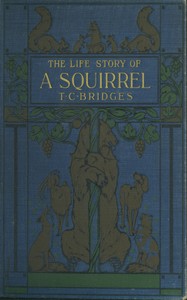
The life story of a squirrel — A Closer Reading
(6 User reviews)
1568
Project Gutenberg
2022
Not confirmed
Squirrels -- Juvenile fiction; Squirrels -- Juvenile literature
Readers of public-domain and historical texts
Project Gutenberg digital edition
en
Edition facts
Words
55,148
Reading time
240 min
Text sections
14
The source record for The life story of a squirrel — A Closer Reading measures this digital text at 55,148 words, 4 hr estimated reading time, and 14 detected text sections.
The text analysis averages about 21.4 words per sentence, while the detected sections provide another way to judge how the source is divided.
Project Gutenberg metadata also associates the work with “Squirrels -- Juvenile fiction,” connecting these edition facts with the source record’s subject description.
Source:
Project Gutenberg record #68252
A first-person squirrel autobiography from 1907, following Scud from a nervous first leap through encounters with weasels, wild-cats, and human hunters, told in a naturalist's voice with animal dialogue and woodland detail.
Editorial Edition Score
4.8/5
★★★★★
★★★★★
Calculated from edition completeness, EPUB availability, text structure and catalogue metadata. Not a user rating.
How this score is calculated
- Description quality20 pts
- Title & short description10 pts
- Source metadata20 pts
- Text length15 pts
- Chapters / structure15 pts
- EPUB file integrity20 pts
Total of 100 points, scaled to a 2.5-5.0 range. Editions with an empty description or a missing EPUB file are not scored.
Edition quality
Read the Text
too much for me. I took my courage in both fore-paws, set my teeth, and launched myself desperately into the air. I came down flat on my little white stomach, but as at that time I weighed rather less than four ounces, and the bough below was soft and springy, I did not knock the wind out of myself, as one of you humans would have done if you had fallen in the same way.
Mother gave a little snort. She did not approve of my methods, and told me I should spread my legs wider and make more use of my tail. Then she turned and gave a low call to Rusty to follow.
Even at that early age—we were barely a month old—Rusty was a heavier and rather slower-going squirrel than I. But he already showed that bull-dog courage which was so strong a trait all through his after-life. He crawled deliberately to the very end of the branch, then simply let go and tumbled all in a heap right on the top of us. It was extremely lucky for him that mother was so quick as she was. She made a rapid bound forward, and caught her blundering son by the loose skin at the back of his neck just in time to save him from going headlong to the ground, quite fifty feet below.
She panted with fright as she lifted him to a place of safety with a little shake.
Rusty looked a trifle sulky, and mother gave him an affectionate pat to soothe him down.
Then she told us to follow her back along the branch, and she would show us how to climb up the trunk home again. She sent me first.
I had hardly reached the trunk end of the bough when I heard mother utter a cry which I had never heard her give before. It was a low sharp call. Oddly enough, I seemed to know exactly what it meant. At once I lay flat upon the bough, here quite thick enough to hide my small body, and crouched down, making myself as small as possible. At the same instant mother seized Rusty by the scruff of his neck, and with one splendid leap sprang right up on to the wide, thick bough on the flat surface of which our home was built. In a few seconds she came back for me, and before I knew what was the matter I, too, was safe in the nest, alongside Rusty and my sister, little Hazel.
Mother gave a low note of warning that none of us should move or make any noise; and you may be sure we all obeyed, for something in her manner frightened us greatly. Presently we heard heavy footfalls down below rustling in the dry pine-needles. We sat closer than ever, hardly daring to breathe. The footsteps stopped just below our tree, and a loud rough voice, that made every nerve in my body quiver, shouted out something. From the sound of it we could tell that the speaker was peering right up between the boughs into our tree, and we knew without the slightest doubt he had discovered our drey. He must have spoken loud, even for a human, for his companion gave a sharp ‘S-s-sh!’ as if he were afraid that some one else might overhear and come down upon them. It could not have been of us he was afraid, for we, poor trembling, palpitating little things, lay huddled together, hardly daring to breathe.
The two tormentors turned away a few paces after a few lower-toned remarks, and I began to think they had gone, when——
Crash, a great jagged lump of stone came hurtling up within a yard of our home, frightening us all abominably.
Mother crouched with us closer than ever into our frail little house of sticks, which was not made to stand the force of stones.
Almost immediately there fell another mass of whizzing stone, even nearer than the first. It shore away a large tassel from the bough just overhead, and this fell right on the top of us, frightening Hazel so much that she jumped completely out of the nest, and, if mother had not been after her as quick as lightning, she must have fallen over the edge and probably tumbled right down to the ground and been killed at once. Even a squirrel, particularly a young one, cannot fall fifty feet in safety.
The narrator, a red squirrel named Scud, begins his story on a June morning, shivering on a larch bough, afraid to jump. The opening paragraph establishes a precise sensory world—'the hot resinous scent of pine-needles'—and a voice that is both animal and articulate. Scud admits he is not giddy, 'a squirrel never is,' but the distance to his mother below feels immense. This first adventure, a leap of faith, sets the pattern for a life story built around physical challenges and narrow escapes. The book belongs to a series called 'Animal Autobiographies,' and Bridges uses the first-person form to blend natural history observation with a fictional squirrel's perspective, complete with named companions like Rusty and Hazel.
A Squirrel's Voice and World
Scud's narration is the book's central device. He describes his world through squirrel senses—scent, sound, and the constant awareness of height and distance. The prose is direct and unadorned, with occasional colloquial touches: 'What's up?' inquired I. The animal characters speak in a plain, conversational English, without sentimentality. The natural setting is rendered with specificity: larch, beech, Spanish chestnut, pollard oak. Bridges includes details of squirrel behavior—rummaging for mast, hiding in knot-holes, the fear of falling—that ground the fantasy in observable fact. The result is a voice that feels both invented and informed, a creature who can describe a wild-cat's 'grey coat, stiff and coarse' and also joke about pheasants making 'jeering remarks.'
Encounters with Danger
The excerpts show a pattern of threat and escape. Early chapters introduce a weasel, then a fox, but the most striking predator is the wild-cat, described by a traumatized stranger: 'a great cat had sprung out of a patch of dead bracken' and killed his brother with 'two quick swings of her terrible paws.' The description is precise and visceral—the cat's 'velvet-cushioned paws,' her 'short tail, broad head, and small, close-rounded ears.' Later, human hunters appear: 'the little stout man with the mutton-chop whiskers, his white-collared, pasty-faced son, and a tall keeper with a ginger beard.' These are not generic villains but specific, almost caricatured figures. The squirrels learn to assess risk, distinguishing between incompetent shooters and real threats like the new keeper.
The Social Life of the Coppice
Scud's world is populated by named squirrels—his mother, his brother Rusty, his eventual wife Hazel—and a network of other animals. The stranger with the wild-cat wound is given a voice and a story; he is not merely a plot device. The squirrels share information, warn each other, and offer food: 'Come with us up into our beech-tree, and I'll find you a better breakfast.' There is a sense of community and territory, with a 'coppice' as home ground. The book also includes other species: pheasants who 'made jeering remarks,' a dog that 'bounded high' in the final illustration. The social structure is hierarchical and cautious, with older squirrels passing down knowledge—'Mother says that a very old squirrel once told her that his father had seen a wild-cat.'
Structure and the Reader's Path
The table of contents reveals a clear arc: from 'My First Adventure' through 'The Great Disaster,' 'The Pleasures of Imprisonment,' 'A Day in Rat Land,' and back to the woodlands, then a series of escalating threats—'The Grey Terror,' 'War Declared Against Our Race,' 'Poachers and a Battue'—ending with 'My Last Adventure.' The chapter titles promise both episodic adventure and a cumulative life story. The illustrations by Allan Stewart, listed with captions, offer visual anchors: 'Father leaped straight towards the boy, landing actually on his shoulder,' 'Two cruel green orbs set in a wide grey face.' A first-time reader can follow Scud's growth from a fearful youngster to an experienced adult, facing predators both natural and human, in a narrative that balances observation with drama.
Bridges wrote within a specific Edwardian tradition of animal autobiography, aiming to instruct as well as entertain. The book rewards a reader who pays attention to the natural details—the scent of pine, the texture of bark, the habits of prey and predator—while also enjoying the invented drama of Scud's voice. The excerpts suggest a work that is more interested in the squirrel's perspective than in plot mechanics, so a patient reading that savors the descriptive passages will yield more than one that rushes toward action. The final chapter's title hints at an ending, but the excerpts do not reveal it.
-

Wendy Larson - 4 weeks ago
While the subject matter could be fascinating, this book is excessively anthropomorphic, giving the squirrel human thoughts and emotions that feel forced and unrealistic. The narrative meanders, with too much emphasis on poetic description and not enough factual content. I wanted a natural history, but instead I got a fable. Disappointing for those seeking a real insight into squirrel behavior. -
Rebecca Heather Frazier - 3 weeks ago
The Life Story of a Squirrel offers an interesting and often heartwarming perspective on the life of this common creature. The writing is descriptive and engaging, though sometimes overly sentimental. The pacing can be slow in the middle, but the final chapters are rewarding. Recommended for nature enthusiasts, but not for those seeking a fast-paced narrative. -
Anna Matthew Lester - 2 weeks ago
A beautifully written and deeply moving account of a squirrel's life. The author anthropomorphizes the squirrel with such tenderness that you forget you're reading a nature book. The vivid descriptions of the forest, the changing seasons, and the squirrel's daily struggles and triumphs create an immersive experience. It's both educational and emotionally resonant, perfect for readers of all ages.
Reader reflection
How will you remember this book?
Save your reaction, strongest insight, and memorable passage.
Your progress
0
/
10
2
How much did you enjoy the reading experience?
3
How likely are you to recommend this book?
4
How easy was the book to follow?
5
Did it raise ideas you would like to talk about?
6
What was the strongest part of the book?
7
Did anything about the book feel genuinely new?
8
How clearly were the main ideas presented?
9
What is the main idea you are taking away?
10



Luke Hill
4 weeks ago