About 280 minutes
The Poor Man — Key Ideas to Explore
Science Fiction Utopias
64,224 recorded words. 14 minutes difference from this book's estimate.
View Gutenberg source #67195
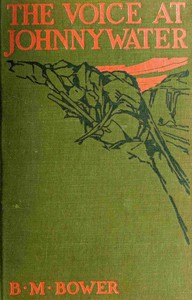
The source record for The voice at Johnnywater — Themes and Context measures this digital text at 67,452 words, 4 hr 54 min estimated reading time, and 38 detected text sections.
The text analysis averages about 16.4 words per sentence, while the detected sections provide another way to judge how the source is divided.
Project Gutenberg metadata also associates the work with “Western stories,” connecting these edition facts with the source record’s subject description.
Explore this collection
These alternatives are selected using recorded categories and estimated reading time.
About 280 minutes
Science Fiction Utopias
64,224 recorded words. 14 minutes difference from this book's estimate.
View Gutenberg source #67195About 275 minutes
Science Fiction Utopias
63,141 recorded words. 19 minutes difference from this book's estimate.
View Gutenberg source #66465About 270 minutes
Science Fiction Utopias
61,884 recorded words. 24 minutes difference from this book's estimate.
View Gutenberg source #65383Search stored excerpts and compare books → Choose by your preferences →
Choices use stored catalog measurements. Estimates vary with reading speed. A shared category is a catalog label, not a claim that two books have the same argument or literary quality.
Search reads excerpt text stored with this catalog and links to its associated Gutenberg record. The connection is stored in the site database; this tool does not recheck that every excerpt is word-for-word identical to that external record. Excerpt search does not cover every chapter and does not verify historical publication dates.
Catalog snapshot checked: 2026-09-26. Coverage: 95 public books, 95 available source excerpts.
Calculated from edition completeness, EPUB availability, text structure and catalogue metadata. Not a user rating.
Total of 100 points, scaled to a 2.5-5.0 range. Editions with an empty description or a missing EPUB file are not scored.
Public-domain source text
The source text is kept in the dedicated reader, separate from this catalogue record and its commentary.
The novel begins not on the range but in a city apartment, where Gary Marshall, his skin still painted copper from a theatrical performance, answers an insistent telephone. The opening image—greasepaint itching, a performer caught between roles—signals a story built on disguise and misdirection. Within pages, Gary is headed to the desert, and the narrative shifts to a landscape of sand, corrals, and log cabins. Bower structures the tale around abrupt transitions: from telephone to trail, from urban to remote, from the mundane to the uncanny. The table of contents, with chapter titles like “The Voice” and “That Cat Ain’t Human!,” hints at a plot driven by ambiguous threats and unexplained occurrences.
The first chapter, “Patricia Entertains,” establishes a pattern of dual settings. Gary’s apartment is a space of modern convenience—an automatic telephone, a hall door—but his theatrical makeup marks him as someone accustomed to playing parts. The call from Patricia, the woman he hopes to marry, propels him into a different world. By Chapter Two, the scene has shifted to the desert, where Gary’s urban identity is shed for a rougher role. Bower uses these contrasting environments to create a sense of dislocation. The reader, like Gary, is never fully settled in one place. The telephone’s “insistent summons” gives way to the “chug of a motor” and the silence of the bluff. This movement between city and wilderness is not merely geographic; it reflects a deeper tension between performance and authenticity, between what is seen and what is hidden.
Recurring images anchor the mystery. A pinto cat appears repeatedly, described as an “expert huntress” that prowls the bluff and vanishes. Gary observes her habits, noting she “kept a private game preserve” somewhere above. The cat is both a natural creature and a symbol of elusiveness. Alongside her, a phantom man is glimpsed—or imagined. James Blaine Hawkins claims to have seen someone in the cabin, but Gary insists no one was there. The dialogue circles around this gap: “You claimed to see a man—and there wasn’t any man.” Bower leaves the truth ambiguous, letting the reader weigh the characters’ competing accounts. The cat and the man become paired motifs of the unseen, their reality questioned by the narrative’s own structure. The chapters titled “The Voice” and “That Cat Ain’t Human!” suggest that the boundary between natural and supernatural is deliberately blurred.
Bower’s dialogue often functions as a verbal duel, with characters testing each other through silence and evasion. In the excerpt, Gary and Hawkins engage in a tense exchange where Gary’s laconic replies provoke Hawkins’ bluster. “Well, why don’t you say something?” Hawkins demands. Gary’s response—“I do know a damn sight more than I’m saying”—is typical of the novel’s withholding style. Conversations are layered with subtext; characters speak around secrets rather than revealing them. This technique builds suspense without relying on action. The standoff at the cabin, with Gary leaning against the wall and Hawkins advancing with clenched fists, is a physical manifestation of the verbal sparring. Bower uses these confrontations to advance the plot while keeping the central mystery intact. The reader, like Hawkins, is left to infer what Gary knows but will not share.
The novel’s structure relies on rapid scene shifts that mirror the characters’ restlessness. Chapter titles like “Gary Rides to Kawich” and “Gary Follows the Pinto Cat” indicate a narrative driven by movement across the desert. Bower often cuts from a tense interior conversation to an exterior action—a ride, a motor chugging, a cat’s prowl. This rhythm prevents any single location from becoming static. The desert itself is a character, described in terms of sand, altitude, and isolation. Gary’s horse, Jazz, and the sorrel’s rubbing-down are small details that ground the story in physical reality. Yet the movement is not always purposeful; characters circle back, as Hawkins does after fleeing. The pattern of departure and return, of glimpsing and losing sight, reinforces the theme of elusive truth. The reader is always in transit, never fully arriving at an answer.
Readers attentive to Bower’s use of recurring images—the pinto cat, the voice, the unseen man—will find a narrative that rewards careful observation. The novel’s structure, built on movement between city and desert, dialogue and silence, invites scrutiny of what is said versus what is shown. Treat each chapter as a piece of a puzzle that may not be fully assembled until the final pages. The mystery at Johnnywater is as much about perception as about plot.
That voice at Johnnywater stayed with me—how a place can hold a secret and pull you toward it, like the desert itself. It made me think of quiet reckonings, the kind that settle in slowly. Anthony John Anthony John — Key Ideas to Explore carries a similar weight, a tenderness around identity and belonging that I found myself turning over long after the last page.
Build a private reading journal entry for this title.