About 568 minutes
The Warden of the Marches — Inside the Classic
Science Fiction Utopias
130,459 recorded words. 74 minutes difference from this book's estimate.
View Gutenberg source #66229
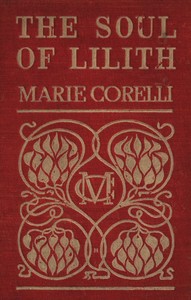
The catalog record for The soul of Lilith — Themes and Context provides practical reading context through 147,488 words, 10 hr 42 min estimated reading time, and 15 detected text sections.
The text analysis averages about 20.5 words per sentence, while the detected sections provide another way to judge how the source is divided.
Project Gutenberg metadata also associates the work with “Paranormal fiction,” connecting these edition facts with the source record’s subject description.
Explore this collection
These alternatives are selected using recorded categories and estimated reading time.
About 568 minutes
Science Fiction Utopias
130,459 recorded words. 74 minutes difference from this book's estimate.
View Gutenberg source #66229About 462 minutes
Science Fiction Utopias
106,046 recorded words. 180 minutes difference from this book's estimate.
View Gutenberg source #68610About 447 minutes
Science Fiction Utopias
102,645 recorded words. 195 minutes difference from this book's estimate.
View Gutenberg source #68296Search stored excerpts and compare books → Choose by your preferences →
Choices use stored catalog measurements. Estimates vary with reading speed. A shared category is a catalog label, not a claim that two books have the same argument or literary quality.
Search reads excerpt text stored with this catalog and links to its associated Gutenberg record. The connection is stored in the site database; this tool does not recheck that every excerpt is word-for-word identical to that external record. Excerpt search does not cover every chapter and does not verify historical publication dates.
Catalog snapshot checked: 2026-09-26. Coverage: 95 public books, 95 available source excerpts.
Calculated from edition completeness, EPUB availability, text structure and catalogue metadata. Not a user rating.
Total of 100 points, scaled to a 2.5-5.0 range. Editions with an empty description or a missing EPUB file are not scored.
Public-domain source text
The source text is kept in the dedicated reader, separate from this catalogue record and its commentary.
Marie Corelli’s The Soul of Lilith opens not with the supernatural but with a crowded theatre, where a new Hamlet delivers the “To be or not to be” soliloquy. The narrative pace is deliberate: the actor sits, pauses, and speaks with “slow and meditative richness.” This measured beginning contrasts sharply with the sudden, noiseless entrance of a man who will become the story’s central figure. The shift from public spectacle to private, occult inquiry is foreshadowed in the very first chapter’s structure—a movement from collective attention to solitary obsession.
The novel’s early chapters alternate between social scenes and the secluded chambers of El-Râmi, the scientist who has summoned Lilith. The theatre scene is crowded, bright, and filled with dialogue from Shakespeare; soon after, the setting contracts to a silent room where El-Râmi studies Lilith’s “rapt expression” and “sweet shut lips.” The prose slows accordingly. Where the opening paragraphs describe audience reactions and stage business, later passages dwell on single gestures—the holding of a hand, the closing of eyes. Corelli uses this deceleration to signal a shift from external action to internal, metaphysical tension. The reader is drawn into a space where time itself seems suspended, broken only by Lilith’s sudden, urgent commands: “Write!”
When Lilith speaks, the narrative rhythm changes again. Her lines are marked by repetition and parallelism: “O wild world!—sad world!—world wherein the pride of wealth…” The dashes and exclamations create a breathless, incantatory quality. Corelli gives her a distinct cadence, different from El-Râmi’s more measured, questioning tone. Lilith’s prophecies are delivered in long, flowing sentences that accumulate warnings: “Wars shall prevail; plague and famine shall ravage the nations.” The shift from intimate dialogue to prophetic monologue is abrupt, and the text signals this through physical description—Lilith grows paler, her head sinks back. The voice itself becomes a structural device, marking moments of heightened emotional and thematic intensity.
El-Râmi’s speech is frequently broken by dashes, questions, and self-corrections. He asks, “Dreaming or waking, is she?” and later “Why will you talk of love!” These interruptions create a staccato rhythm that contrasts with Lilith’s fluency. Corelli uses punctuation to convey his uncertainty: he “strove in vain to assume its wonted firmness.” The narrative voice itself becomes hesitant, with phrases like “By and by he began to collect his ideas.” This stylistic choice mirrors the scientist’s intellectual struggle—he is a man accustomed to control, yet here he is repeatedly thrown off balance. The pauses in the text (marked by dashes and ellipses) become as significant as the words spoken, emphasizing the gaps in understanding between the mortal and the supernatural.
Readers attentive to Corelli’s prose will notice how she manipulates sentence length and punctuation to reflect the characters’ psychological states. The novel’s pace is not uniform; it accelerates during Lilith’s prophecies and slows during El-Râmi’s reflections. Watching these shifts offers a way into the book’s central tension between scientific reason and mystical revelation. The excerpts suggest that the story’s power lies less in plot than in the rhythm of its dialogues and the weight of its silences.
That rainy afternoon, The Soul of Lilith kept me suspended in its hushed, prophetic dialogues, the stillness oddly thrilling. Later, as the light faded, I found myself drifting toward something altogether more grounded and stark—the quiet, procedural dread of The Millbank Case: A Maine Mystery of To-day — Themes and Context. A strange pairing, yet both left the same aftertaste: secrets wearing ordinary faces.
Build a private reading journal entry for this title.