About 326 minutes
Mr. Clutterbuck's Election — Story, Setting & Ideas
Science Fiction Utopias
74,828 recorded words. 4 minutes difference from this book's estimate.
View Gutenberg source #66671
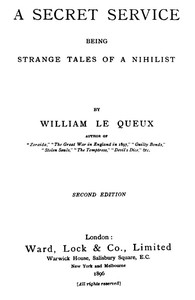
For A Secret Service: Being Strange Tales of a Nihilist — Background and Themes, the stored edition analysis reports 73,990 words, 5 hr 22 min estimated reading time, and 18 detected text sections.
The text analysis averages about 17.5 words per sentence, while the detected sections provide another way to judge how the source is divided.
Project Gutenberg metadata also associates the work with “Nihilism -- Fiction,” connecting these edition facts with the source record’s subject description.
Explore this collection
These alternatives are selected using recorded categories and estimated reading time.
About 326 minutes
Science Fiction Utopias
74,828 recorded words. 4 minutes difference from this book's estimate.
View Gutenberg source #66671About 326 minutes
Science Fiction Utopias
74,896 recorded words. 4 minutes difference from this book's estimate.
View Gutenberg source #66968About 328 minutes
Science Fiction Utopias
75,349 recorded words. 6 minutes difference from this book's estimate.
View Gutenberg source #65588Search stored excerpts and compare books → Choose by your preferences →
Choices use stored catalog measurements. Estimates vary with reading speed. A shared category is a catalog label, not a claim that two books have the same argument or literary quality.
Search reads excerpt text stored with this catalog and links to its associated Gutenberg record. The connection is stored in the site database; this tool does not recheck that every excerpt is word-for-word identical to that external record. Excerpt search does not cover every chapter and does not verify historical publication dates.
Catalog snapshot checked: 2026-09-26. Coverage: 95 public books, 95 available source excerpts.
Calculated from edition completeness, EPUB availability, text structure and catalogue metadata. Not a user rating.
Total of 100 points, scaled to a 2.5-5.0 range. Editions with an empty description or a missing EPUB file are not scored.
Public-domain source text
The source text is kept in the dedicated reader, separate from this catalogue record and its commentary.
William Le Queux opens A Secret Service with a preface that blurs reportage and fiction, claiming acquaintance with the original of his protagonist, Anton Prèhznev, while writing articles for The Times on Russian revolutionaries. This documentary tone quickly gives way to a narrative voice that oscillates between measured exposition and visceral, breathless recollection. The text’s pacing is uneven by design: long passages of political context are punctuated by sudden, sensory-driven fragments—tuberoses and chloroform, a revolver shot, a body floating in the Meuse. Readers should attend to these shifts, as they signal the story’s movement from public indictment to private trauma.
The first-person narrator of A Secret Service speaks in two registers. In the preface and explanatory passages, he adopts the detached, analytical voice of a journalist: “While writing for The Times a series of articles dealing with the Russian Revolutionary movement.” But when recounting his own entanglement—the trap in Onslow Square, the murder of Axinïa, the scent of tuberoses—the prose becomes fragmented and exclamatory: “Bah! How I detest tuberoses! Their odour is gruesome. There is death in their breath.” This alternation is not merely stylistic; it reflects a tension between the narrator’s role as chronicler of political oppression and his personal experience of violence and betrayal. The reader is left to judge how far the “strange tales” are shaped by the need to make sense of trauma.
Le Queux manipulates narrative speed to create unease. The early chapters move deliberately, building context around Nihilist activity and the corruption of the Tsarist regime. Then, without warning, the tempo accelerates into a chaotic sequence: the narrator is lured to a house, nearly suffocated, dragged unconscious through rooms, and later told he was framed for murder. The resolution of this episode arrives in a single, dense paragraph of explanation from Ivan Ivanovitch, compressing weeks of intrigue into a few sentences. Elsewhere, the prose slows to dwell on sensory details—the “fœtid, poisoned atmosphere” of dungeons, the “trackless snows” of Siberia—that anchor the political critique in physical horror. These changes in pace are not arbitrary; they mirror the narrator’s loss of control and the sudden, arbitrary violence of the world he describes.
Two sensory motifs recur across the excerpts: the smell of tuberoses and the whiff of chloroform. The narrator’s visceral reaction to tuberoses—“There is death in their breath”—links the flower to the memory of a murder scene, while chloroform evokes the clinical brutality of the surgeon or the assassin. These motifs appear at moments of high tension, cutting through the political discourse to ground the story in bodily experience. They also serve as a structural device: the narrator’s inability to forget the scent mirrors the reader’s inability to dismiss the violence as mere backdrop. Le Queux uses these recurring details to bind together the disparate “strange tales,” suggesting that beneath the conspiracy and espionage lies a persistent, unassimilable horror.
Readers will find that the book’s power lies less in its plot mechanics—which can feel contrived—than in its atmospheric intensity and the narrator’s fractured voice. Pay attention to the moments when the prose breaks into exclamation or sensory overload; these are the points where the political thriller becomes a psychological document. The preface’s claim to factual basis may be a framing device, but it also invites the reader to consider how far the “strange tales” reflect real anxieties about state power and personal safety in late-Victorian Europe.
Le Queux’s tales left me restless, that odd hum of paranoia under ordinary streets. I kept thinking about how fear shrinks a person’s world. Then I found The Poor Man — Key Ideas to Explore, and it softened that same ache—not the conspiracy, but the quiet weight of never having enough room to breathe. It lingers differently, more like a held breath than a chase.
Answer a few questions and save a private reflection on this device.